

New Impetus For CEMAC, ECCAS: Leveraging Harmonized Regulations To Drive Regional Trade
- Par Kimeng Hilton
- 18 Mar 2026 18:33
- 0 Likes
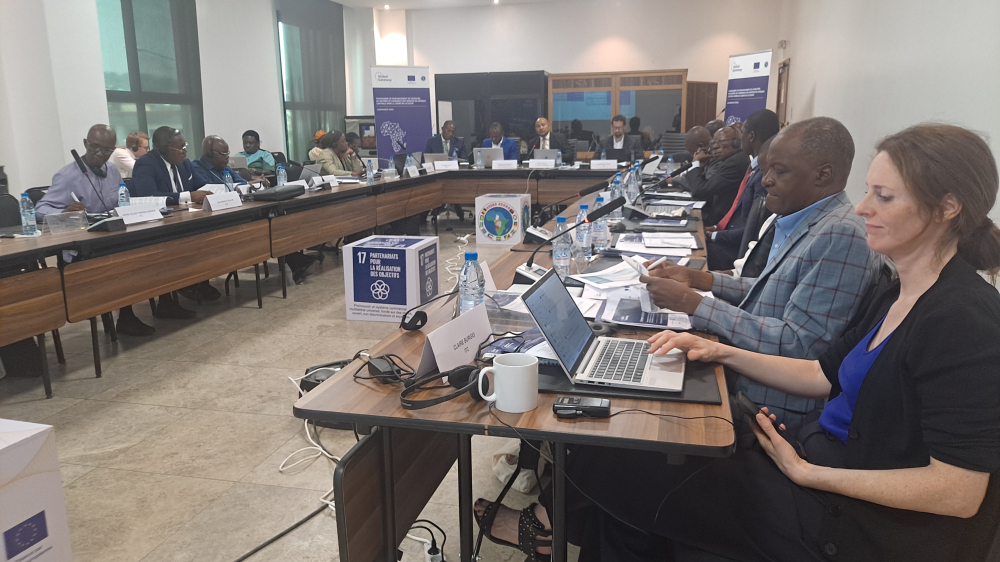
The first Steering Committee meeting of the Capacity Building Programme on Trade Services in Central Africa held in Yaounde on March 18, 2026.
In the quiet diplomatic enclave of the Bastos district of the Cameroonian capital, Yaounde, history was written not with ink, but with strategy. On March 18, 2026, the Economic Community of Central African States, ECCAS, in partnership with the International Trade Centre, ITC and with the financial backing of the European Union, EU, convened the first Steering Committee meeting of the Capacity Building Programme on Trade in Services in Central Africa. As part of the Africa Continental Free Trade Area, AfCFTA framework.
For too long, Central Africa has remained a region of immense potential, but fragmented reality. Rich in natural resources and human capital, yet boasting intra-regional trade figures that languish at a dismal 2%. The region has long struggled to translate its geographic proximity into economic unity. But the narrative has now shifted.
Talking Time Is Over
Representing ECCAS, Jacob Kotcho, addressed the media after the opening ceremony. His message was clear and urgent: the time for talking was over; the time for implementation had begun. "The trade services industry is vast - 12 sectors and 156 sub-sectors," Kotcho said. "The task ahead is therefore huge and we have to work hard."
This meeting marked the critical transition from the programme's inception phase, which began in February 2025, to its full operational implementation. It signaled the official green light for a €6.2 million investment funded by the European Union under the Global Gateway Africa-Europe initiative. The objective is ambitious yet essential: to dismantle the regulatory walls that stifle the services sector, thereby unlocking the economic engine of the continent.
The "Invisible Engine" Of The Economy
To understand the significance of this programme, one must first understand the nature of the beast it seeks to tame. Trade in services is often described as the "invisible" sector, overshadowed by the tangible movement of goods - oil, timber, and minerals that dominate the headlines. However, as Kotcho eloquently argued during the session, services are the lifeblood of commerce.
"In terms of its contributions to wealth creation in ECCAS member nations, the trade services industry contributes at least 50 per cent," Kotcho noted. "This is therefore a sector of the economy with added value." He deployed a powerful analogy to illustrate the symbiotic relationship between goods and services: "Trade in services is as important as oil to a car engine. It enables companies to operate."
Without the lubrication of logistics, the assurance of insurance, the precision of accounting, or the framework of legal services, the trade in goods grinds to a halt. A truck carrying cocoa from Cameroon cannot reach a market in Rwanda without the services of transport logistics; a multinational corporation cannot invest in the Democratic Republic of Congo without legal and financial services.
So Negligible
Yet, despite contributing half of the region's Gross Domestic Product, GDP, trade in services in Central Africa remains negligible as far as integration is concerned. The barriers are not tariffs, which are easy to see, but regulations - which are difficult to navigate. Divergent licensing requirements, incompatible professional standards, and opaque bureaucratic procedures have turned the region's borders into formidable barriers for service providers.
The ECCAS-Services programme seeks to change this dynamic. It aims to facilitate the harmonization of regulations across different trade and service industries, creating a seamless environment where a Cameroonian architect can practise in Gabon, or a Chadian logistics company can operate freely in Burundi.
A Strategic Pivot
The March 18, 2026 meeting was technically a gathering of the Steering Committee, COPIL, the strategic governance body of the programme. But functionally, it was a rubber-stamping ceremony for a new economic doctrine. The agenda was rigorous, reflecting the complexity of regional integration.
The primary objective was to validate the inception phase report and the first year of the programme. The International Trade Centre, ITC, the executing agency, had spent the previous year laying the groundwork - putting project governance instruments in place, preparing action plans, and identifying priority areas. These efforts were presented to the member states for approval.
"We focused on five priority sectors earlier identified, but also discussed other sectors," Kotcho revealed. However, in a display of pragmatic realism, he acknowledged the constraints of the budget. "Because of limited funding, we are not going to engage all five initial sectors identified earlier."
Strategic Focus
This decision highlights the strategic focus of the programme. Rather than spreading the €6.2 million too thin across the massive expanse of the trade services industry, the committee decided to prioritize specific sectors where the impact would be most profound. While the specific selected sectors were a subject of intense discussion, the commitment was to move forward with a concentrated, results-driven approach.
The committee officially validated the Terms of Reference for the Steering Committee and the Operational Monitoring Committee, CSO. They approved the annual work plan for February 2026 to January 2027 and endorsed the logical results framework and key performance indicators. These are the nuts and bolts of international development projects, but in Yaounde, they represented the architectural plans for a new economic building.
Investment In African Autonomy
The financial engine behind this project is the European Union’s Global Gateway strategy, a massive global initiative aiming to mobilize up to 300 billion euros in public and private investment by 2027. In Africa, the Global Gateway is the vehicle for the Africa-Europe Investment Package, with over €150 billion earmarked for the continent.
The ECCAS-Trade Services programme is a direct beneficiary of this geopolitical vision. The EU is not just providing funds; it is providing technical support and a "corridor approach" that aligns with the EU’s interests in fostering stable, sustainable trading partners.
European Green Deal
According to the context provided at the meeting, the programme is designed to "sustainably increase intra-African and EU-Africa trade in services, contributing to the commitments of the European Green Deal." This means that the liberalization of services in Central Africa is not just about economic growth; it is about modernization. The programme emphasizes sectors that can support sustainable development, incorporating climate-related provisions into the regulatory frameworks being developed.
The EU delegation present at the meeting, along with representatives from the Dutch Entrepreneurial Development Bank, FMO, reiterated that this was a partnership based on shared values. The goal is to stimulate the development of more diversified, inclusive, sustainable, and resilient African economies.
Leveraging The CEMAC Advantage
One of the most compelling narratives that emerged from the Yaounde meeting was the recognition of the progress made by the Economic and Monetary Community of Central Africa, CEMAC. Comprising six of the 11 ECCAS member States, CEMAC has often been viewed through a lens of economic stagnation. However, Jacob Kotcho challenged this perception, stating, "Contrary to popular thinking, the six member States of the Economic and Monetary Community of Central Africa, CEMAC, have made tremendous progress in terms of harmonizing the regulatory framework for trade and trade services."
Kotcho pointed out that sectors such as legal services, chartered accounting, and health have already been harmonized within the CEMAC zone. "This is an advantage," he explained, "because the follow-up to be carried out will take into consideration this achievement by CEMAC member States."
Building On Something
This is a crucial strategic insight. It means that the ECCAS programme does not need to start from scratch. By building upon the existing legislative and regulatory architecture of CEMAC, the programme can accelerate the harmonization process for the wider region. It serves as a proof of concept - regional integration is possible, and the legal frameworks can be aligned.
The meeting saw robust participation from the CEMAC Commission, reinforcing the idea that the two regional bodies are not competing, but are complementary. The harmonization of trade laws is the bedrock upon which the AfCFTA will be built. Without these underlying legal structures, the political commitments of the African Continental Free Trade Area remain theoretical.
Alignment With Continental Ambitions
A recurring theme throughout the discussions in Yaounde was the necessity of alignment. The ECCAS-Services programme is not an isolated island; it is a tributary feeding into the great river of African integration. The Steering Committee took great care to confirm the programme's alignment with the Master Plan for Industrialization and Economic Diversification for Central Africa, PDIDE AC.
This alignment ensures that the liberalization of services supports the broader goal of industrialization. Services are not just ends in themselves; they are inputs into industrial production. By improving the efficiency and cost of logistics, communications, and financial services, the programme directly boosts the competitiveness of Central Africa's manufacturing and agriculture sectors.
Timely Synchronization
Furthermore, the programme is synchronized with the African Union’s Agenda 2063 and the AfCFTA Protocol on Trade in Services. The AfCFTA is arguably the most ambitious trade agreement since the creation of the World Trade Organization, aiming to create a single continental market for goods and services. However, the "phase two" negotiations, which cover services and digital trade, are notoriously complex.
This is where the ECCAS programme plays a pivotal role. One of its expected outputs is to "Support for ECCAS States in drafting schedules of specific commitments under the AfCFTA Protocol on Trade in Services." In essence, the programme is helping Central African countries prepare for the negotiation table. It is building the capacity of state negotiators to understand their interests, defend their markets, and capitalize on opportunities elsewhere in Africa.
Human-Centric Approach
While the discussions in Yaounde were steeped in the technical language of "regulatory frameworks" and "harmonization," the ultimate beneficiaries of the programme are the people of Central Africa. The programme document explicitly states that the final beneficiaries are the Small and Medium-sized Enterprises, SMEs involved in service exports, with a particular emphasis on businesses owned and led by women and youth.
This focus on inclusion is not just window dressing; it is an economic imperative. The services sector offers lower barriers to entry for women and young entrepreneurs compared to capital-intensive industries like mining or manufacturing. Whether it is tourism, ICT, or creative services, the sector is a potent tool for job creation.
Priority On Women, Youth
The programme aims to strengthen the awareness of export opportunities for these demographic groups. "Awareness of export opportunities is strengthened for the private sector, particularly for businesses led by women and youth," reads the programme's expected results. By connecting local SMEs to regional and continental value chains, the programme aims to democratize the benefits of trade.
The presence of the High Council of Business, HCA and private sector focal points at the Steering Committee meeting underscored this commitment. The message was clear: this is not a governme...
Cet article complet est réservé aux abonnés
Déjà abonné ? Identifiez-vous >
Accédez en illimité à Cameroon Tribune Digital à partir de 26250 FCFA
Je M'abonne1 minute suffit pour vous abonner à Cameroon Tribune Digital !

- Votre numéro spécial cameroon-tribune en version numérique
- Des encarts
- Des appels d'offres exclusives
- D'avant-première (accès 24h avant la publication)
- Des éditions consultables sur tous supports (smartphone, tablettes, PC)






Commentaires