

The Shadow Electorate: Why 15% of Cameroonians Are Mute At The Polls
- Par Kimeng Hilton
- 22 Apr 2026 06:25
- 0 Likes
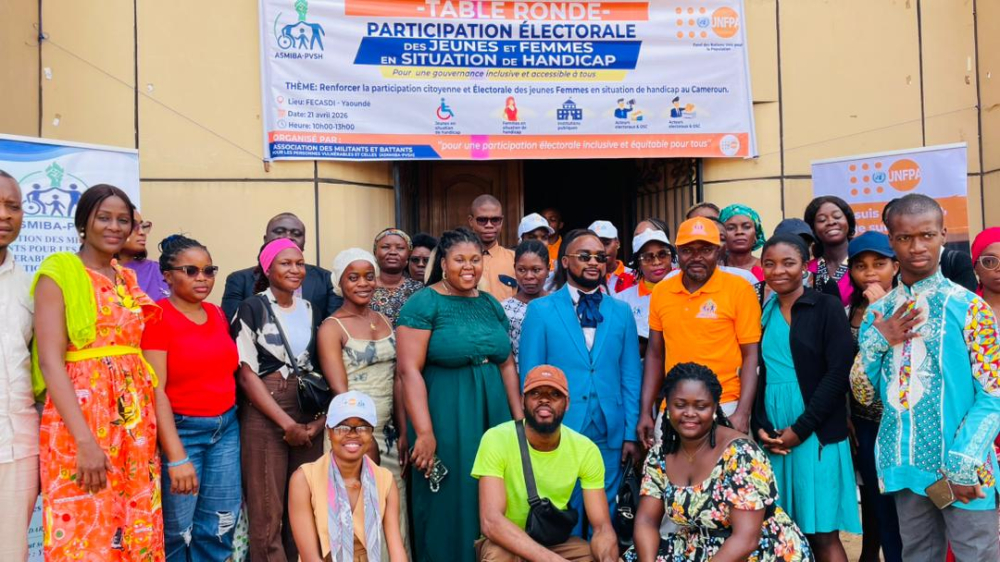
The Association of Advocates and Fighters for Vulnerable People and Those Living with Disabilities (ASMIBA-PVSH), held a round table on the political participation of people with disabilities in Yaounde on April 21, 2026.
In the heart of Cameroon’s political capital, Yaoundé, a profound demographic irony persists. While the nation’s constitution trumpets equality and civic duty, a significant portion of the populace - approximately 15%—remains functionally disenfranchised. On April 21, 2026, the Association of Advocates and Fighters for Vulnerable People and Those Living with Disabilities (ASMIBA-PVSH), led by the visionary researcher Tombi A Sanam Olivier, convened a landmark round table at the FECASDI headquarters Yaounde. This was not merely a meeting; it was a formal indictment of an exclusionary system and a blueprint for a more muscular, inclusive democracy.
The Data of Exclusion
The most damning evidence of political marginalization lies in the numbers. Current data compiled by ASMIBA reveals a "representation desert." Cameroon currently boasts nearly 10,000 municipal councilors, yet a meager 12 are persons living with disabilities. Even more striking is the total absence of youth with disabilities in these local seats, and a zero-percent representation in both the Senate and the National Assembly.
This vacuum means that the specific needs of the disabled community - ranging from accessible urban planning to inclusive healthcare - are debated by people who have no lived experience of those challenges. The round table identified this as a "democratic deficit" that undermines the legitimacy of local governance.
The Three Pillars Of Exclusion
The report identifies that exclusion is not accidental; it is structural. The "Three Pillars" hindering participation are:
• The Physical Barrier: Most polling stations and administrative offices are located in legacy buildings that lack ramps, elevators, or wide doorways. For a wheelchair user, the act of voting becomes a physical impossibility rather than a civic right.
• The Communication Barrier: Democracy is built on information. However, without sign language interpreters at rallies or Braille ballots in booths, the deaf and blind communities are effectively "information-starved," making it impossible to evaluate candidates fairly.
• The Institutional Stigma: There remains a deep-seated bias among political party leaders who view disability as a "weakness" that might alienate voters. Consequently, disabled candidates are rarely placed on party lists, or if they are, they are positioned so low that election is mathematically impossible.
The ‘Double Jeopardy’ Of Women
A central focus of the April 21, 2026 round table was the intersectional struggle of women with disabilities. In many communities, these women face a "double jeopardy" - discrimination based on gender and their physical or mental condition. ASMIBA-PVSH, in partnership with the United Nations Population Fund (UNFPA), argues that empowering these women is the key to social transformation. By providing leadership training and political coaching, the initiative seeks to move women from the periphery of social work into the center of legislative decision-making. The goal is to ensure that "inclusion" is not seen as a charitable act, but as a fundamental human right.
Strategic Advocacy
The methodology of this round table was distinct from previous workshops. It utilized a Strategic Advocacy Model structured around:
• Evidence-Based Reporting: Utilizing the 2023 MINAS/UNDP study showing that 78% of disabled persons feel their concerns are ignored.
• Direct Engagement: Forcing a face-to-face dialogue between disabled youth and institutions like ELECAM and the Ministry of Social Affairs (MINAS).
• The Advocacy Note: The primary output of this event is a formal policy document designed to be tabled before the government. This note will demand mandatory quotas for disability representation on all electoral lists and state-funded accessibility kits for every polling station in the country.
Vision For 2026, Beyond
As Cameroon moves toward future elections, the ASMIBA-PVSH initiative serves as a litmus test for the nation’s commitment to the African Union’s Strategic Plan on Disability (2022). The round table was the first step in creating a national network of "Inclusion Focal Points" - trained leaders who will monitor elections in every region to ensure that no youth or woman is left behind.
A Republic For All
The event at FECASDI signifies a shift in the...
Cet article complet est réservé aux abonnés
Déjà abonné ? Identifiez-vous >
Accédez en illimité à Cameroon Tribune Digital à partir de 26250 FCFA
Je M'abonne1 minute suffit pour vous abonner à Cameroon Tribune Digital !
- Votre numéro spécial cameroon-tribune en version numérique
- Des encarts
- Des appels d'offres exclusives
- D'avant-première (accès 24h avant la publication)
- Des éditions consultables sur tous supports (smartphone, tablettes, PC)


Reactions
De la meme catégorie
Société civile: Le pari de la sensibilisation intense
- 30 Jun 2026 02:15
- 0 likes
Elections Cameroon: Specialised Campaigns In View
- 30 Jun 2026 02:13
- 0 likes


Commentaires