

A Blessing In Oak And Fabric: Wirba Kevin Lemnyuy’s Instant Moment Of Global Recognition
- Par Kimeng Hilton
- 23 Apr 2026 07:00
- 0 Likes
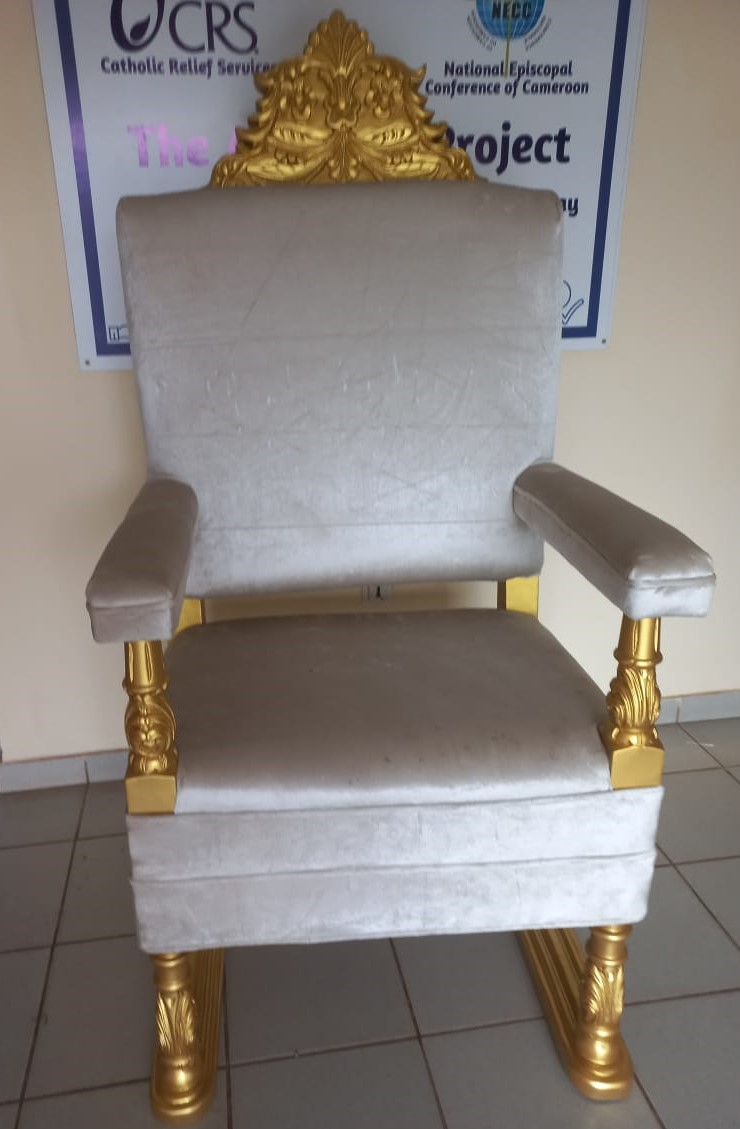
The Yaounde-based furniture maker had the singular honour of being commissioned to produce a chair for Pope Leo XIV during his visit to the Cameroonian capital from April 15-18, 2026.
When the Alitalia flight carrying Pope Leo XIV touched down at the Yaoundé-Nsimalen International Airport in the Cameroonian capital on April 15, 2026, the eyes of the world were fixed on the diplomatic protocols and the spiritual fervor of the faithful. Yet, in a modest workshop in the Olembe neighborhood, one man was looking back at something much more specific: the stability of a silhouette, the grain of the wood, and the precision of a finish.
Wirba Kevin Lemnyuy, 47, is not a household name in the high-stakes world of international diplomacy, but for four days in April, his handiwork was the most scrutinized piece of furniture in Cameroon. He is the man who produced the chair used by the Holy Father during his historic apostolic visit to Yaoundé.
Genesis Of A Master Craftsman
To understand how a boy from Jakiri in Bui Division of Cameroon’s North West Region ended up building a throne for the Bishop of Rome, one must look back to the educational foundations of the late 1970s. Born in 1978, Lemnyuy is a product of the Rural Artisan Training Centre (SAR SM) in Jakiri.
In an era when many sought the perceived prestige of administrative desk jobs, Lemnyuy leaned on the tactile world of woodwork. Completing his formal training in 1993, he embarked on a classic Cameroonian journey of "apprenticeship," moving to the regional capital of Bamenda. Between 1993 and 1995, he honed the delicate balance between structural integrity and aesthetic beauty. A skill set that would, decades later, catch the eye of the National Episcopal Conference of Cameroon (NECC) Centre.
By 1998, Lemnyuy had migrated to the nation's capital, Yaoundé. He began his independent practice at the bustling Carrefour-EMIA before eventually establishing his current base in Olembe. It was this trajectory of steady, quiet excellence that positioned him for the call of a lifetime.
Race Against The Clock
The selection process for a papal visit is usually shrouded in layers of Vatican and local ecclesiastical bureaucracy. However, for Wirba, the opportunity was born from a long-standing relationship of trust.
"I have been doing some work for the National Episcopal Centre in Mvolyé," Wirba explains. It was Monsignor Paul Nyaga, the Secretary General of the NECC, who made the decisive move. Having witnessed the quality of Wirba’s previous work, the Monsignor sent for him just two weeks before the Pope’s arrival.
Rigorous Specifications, Dimensions
The brief was daunting: produce a chair that met the rigorous specifications, dimensions, and aesthetic dignity required for the Vicar of Christ. There was no room for error. The design had to accommodate the physical comfort of the 266th Pope while reflecting the cultural solemnity of the Cameroonian Church.
"He gave me his designs, specifications, and the dimensions," Wirba recalls. "We agreed on everything, and I went ahead and produced the special chair. It took me about 10 days."
Moment Of Global Visibility
For 10 days, the Olembe workshop was transformed into a site of sacred labor. While the artisan remained focused on the joinery and upholstery, the weight of the task began to sink in. When the chair was finally delivered to Mvolyé, the reaction from Monsignor Nyaga was immediate.
"He was very, very happy with the job well done," Wirba says. "He told me he knew I could do it."
When True Validation Came
However, the true validation came not from the clergy, but from the glowing screen of the television. Like millions of others, Wirba watched the coverage of the Papal Mass. But unlike others, his focus was on the seat. Seeing Pope Leo XIV sitting on the throne he had labored over for 10 days brought a sense of overwhelming joy.
"I felt so happy and overwhelmed," he admits. In the age of social media, the news spread fast. Footage of the Pope in Yaoundé began circulating on WhatsApp and Facebook, and Wirba began sharing "behind-the-scenes" photos of the chair’s construction. The reaction from the community was unanimous: it was seen as a divine blessing upon his hands.
The Catholic Artisan’s Identity
Wirba’s involvement was not merely a commercial transaction; it was an act of service to his faith. A devout member of the Catholic Men’s Fellowship (CMA) at Carrefour EMIA, he embodies the intersection of professional skill and religious devotion.
Unfortunately, despite his central role in the logistics of the visit, Wirba was unable to attend the Pontifical Mass at the Yaounde Air Force Base on April 18. The demands of his craft and the logistical crush of the city kept him away, yet he remains unburdened by this. For him, his presence was felt through the wood and fabric that supported the Holy Father.
Call For Structural Change
Beyond the glamour of the papal visit, Wirba Kevin Lemnyuy is using his newfound platform to advocate for the future of his trade. He views his success as a proof-of-concept for the power of technical education in Cameroon.
"We should encourage our children to do technical education, and most especially, woodwork," Wirba asserts. He believes that the government must do more than just offer verbal praise for local artisans; there must be a concerted effort to support those trying to establish themselves in the domain.
His story serves as a poignant reminder that in the heart of Cameroon’s neighborhoods, there are masters of "Made in Cameroon" excellence capable of meeting international standards - even those set by the Vatican.
The Price Of Silence
When pressed on the financial compensation for such a high-profile commission, the artisan maintains a professional and respectful silence. "No! no! It will not be good for the National Episcopal Conference of Cameroon!" he says with a laugh.
For Wirba, the value of the project wasn't found in the CFA Francs earned, but in the "promotion and sensitization" of the public to the heights that a Cameroonian carpenter can reach. As Pope Leo XIV departed Cameroon, he left behind a nation moved by his message. And in a small workshop in Olembe, Yaounde, he left behind a craftsman whose life has been forever changed by a single chair.
The Catholic Artisan’s Identity
Wirba’s involvement was not merely a commercial transaction; it was an act of service to his faith. A devout member of the Catholic Men&...
Cet article complet est réservé aux abonnés
Déjà abonné ? Identifiez-vous >
Accédez en illimité à Cameroon Tribune Digital à partir de 26250 FCFA
Je M'abonne1 minute suffit pour vous abonner à Cameroon Tribune Digital !
- Votre numéro spécial cameroon-tribune en version numérique
- Des encarts
- Des appels d'offres exclusives
- D'avant-première (accès 24h avant la publication)
- Des éditions consultables sur tous supports (smartphone, tablettes, PC)








Commentaires