

Authority Versus Collaboration: Redefining State-Civil Society Relations In Cameroon
- Par Kimeng Hilton
- 13 Dec 2025 16:56
- 0 Likes
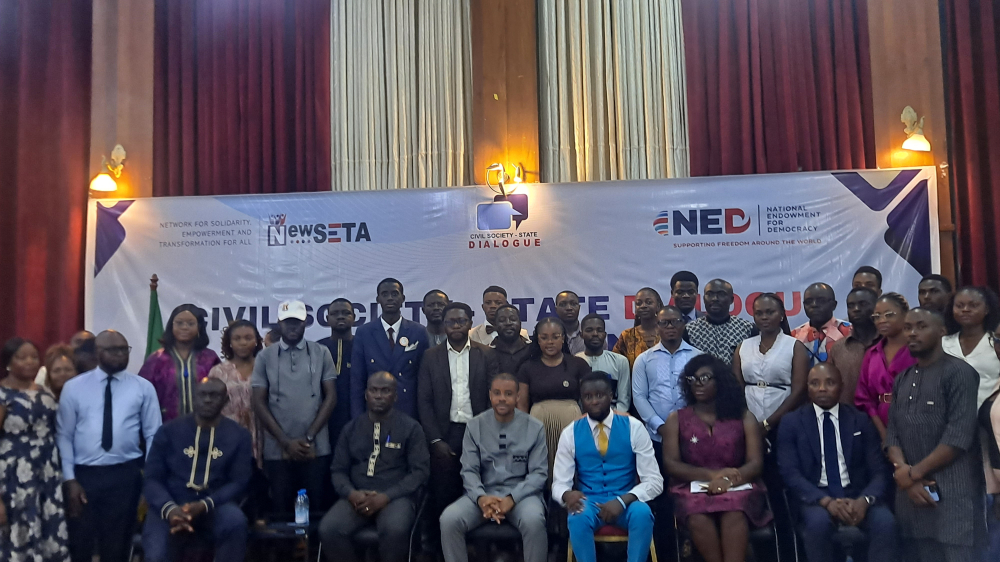
The charity, NewSETA on December 11, 2025 in Yaounde organized a dialogue between Civil Society Organizations, CSOs and the State.
The air in Yaounde on December 11, 2025, was thick with the weight of expectation. Not a physical humidity, but a palpable tension born from years of constrained dialogue, of relationships defined less by partnership and more by power. Here, at the second Civil Society-State Dialogue organized by the Network for Solidarity, Empowerment and Transformation for All, NewSETA, the simple act of sitting together at a table was a radical statement in itself.
Blend Of Participants
The 60 participant - a rare blend of lawmakers, journalists, civil society titans, and high-ranking government officials from the Ministry of Territorial Administration, MINAT, and the Ministry of External Relations, MINREX – attempted to bridge a chasm that many believed was unbridgeable: the shrinking civic space in Cameroon.
The core premise of the gathering was a painful truth articulated by NewSETA’s Executive Director, Ndzi Derick Jitzi: "The civil society does not operate in space. It operates within a rigid regulatory environment.”
It’s Been Long!
For decades, the narrative between Civil Society Organizations, CSOs, and the Cameroonian State has been one of friction, governed by what Jitzi termed an "authority-based" dynamic, rather than a collaborative one. This dialogue, funded by the U.S.-based National Endowment for Democracy, NED, was designed to confront this reality and ask a vital question: Can collaboration replace control?
View From Outside In
The dialogue didn't emerge from a vacuum. It was built upon a foundation of research that exposed the strained nerves of the Cameroonian body politic. NewSETA has been methodically charting the landscape of civic freedoms. A 2019 study examined freedom of expression and assembly, while a 2024 report focused on the right of access to information. The findings were stark, pointing to a persistent relationship where information flows were restricted and assembly rights were routinely challenged.
Not About Cameroon Only
Jitzi emphasized that this trend wasn't unique to Cameroon, noting it was part of a broader continental pattern where "the civic space continues to be restricted... in Sub-Saharan Africa and other African countries." This shared challenge provided a powerful impetus to seek shared solutions.
The dialogue was an intervention, a deliberate push to get the two sides talking about fundamental rights that underpin both CSOs’ and journalists’ work: the right to access information and the right to freedom of expression. The media were invited because they are essential "carriers of good news, they are carriers of messages," facing similar operational challenges in a constrained environment, Jitzi noted.
Law And Order
When government representatives took the floor, their perspectives offered a clear counter-narrative to civil society's concerns. The State’s representatives framed the issue not as one of restriction, but one of compliance.
Dooh Jean-Jacques, the Service Head for Associations in MINAT, offered a straightforward interpretation of the rules of engagement. His ministry’s objective, he stated, is to improve "political life," but this requires order. "Only registered NGOs are allowed to raise funds," he reminded the assembly, "They must act in accordance with their objectives by respecting the laws and regulations of the land," Dooh added.
Classic Catch-22
For MINAT, the relationship is "very good" as long as CSOs adhere to the laws governing the Republic. The organizations that complain about marginalization, Dooh suggested, are simply those "not respecting the law." It’s a classic Catch-22: respect the laws as written, or be labeled a non-compliant actor operating outside the accepted boundaries.
The legislative foundation for this stance rests on the 1990 law of freedom of association and the 1999 NGO law. When pressed on the need for modernization, Jean-Jacques hinted at a future "re-reading of certain provisions," but stopped short of promising a full revision, signaling that change, if it all comes, will be incremental and carefully managed.
A Harmonizing Force?
From the Ministry of External Relations, the tone was one of established partnership. Dr. Nobola Jean Emile, Sub Director for Decentralized Cooperation and Non-governmental Organ...
Cet article complet est réservé aux abonnés
Déjà abonné ? Identifiez-vous >
Accédez en illimité à Cameroon Tribune Digital à partir de 26250 FCFA
Je M'abonne1 minute suffit pour vous abonner à Cameroon Tribune Digital !

- Votre numéro spécial cameroon-tribune en version numérique
- Des encarts
- Des appels d'offres exclusives
- D'avant-première (accès 24h avant la publication)
- Des éditions consultables sur tous supports (smartphone, tablettes, PC)







Commentaires