

A World Without Hunger: In Remembrance Of The Unstoppable Jo Luck
- Par Kimeng Hilton
- 29 Dec 2025 17:15
- 0 Likes
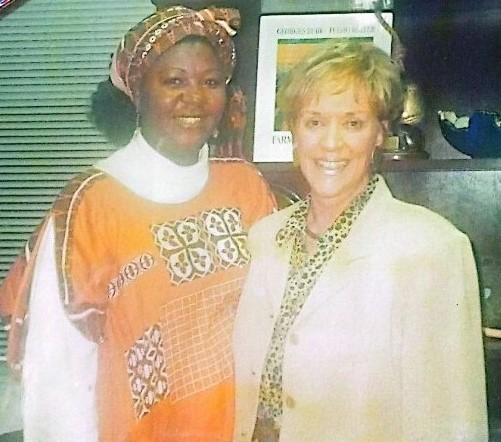
The former President and Chief Executive Officer of Heifer International passed away on November 26, 2025. But former Heifer Cameroon staff continue to treasure her legacy.
December 29, 2025, Yaounde, Cameroon: In the evening of November 26, 2025, the world lost a towering figure in the realm of humanitarian aid. Jo Luck, the former President and Chief Executive Officer of Heifer International, passed away peacefully in the United States. While official obituaries will cite the staggering statistics of her tenure - growing the organization’s annual budget from $7 million to over $130 million and expanding its reach across the globe - those numbers only tell a fraction of the story.
So Distant, Yet So Near
The true measure of Jo Luck’s life lies not in spreadsheets, but in the transformed lives of farmers of Cameroon, the biomedical researchers inspired by rural suffering, and the female leaders who found their voices because she dared to lead.
Jo Luck joined Heifer International in 1989 as the Director of International Programmes, ascending to the role of President and CEO in 1992, a position she held until 2009. She also served as the President of the Heifer International Foundation from 1992 to 2001. But to the staff who worked under her in the far-flung fields of Cameroon, she was not a distant executive; she was the architect of a value system that became their moral compass.
Through Their Voices
Through the voices of her former colleagues in Cameroon - Dr. Eugene Ateh, Mrs. Ngo Ndjon Marie, Emmanuel Basam, Kimeng Hilton Ndukong, Dr Festus K. Ali, Bih Fomukong Atanga, and Dr. Akob Jane - we trace the indelible imprint of a leader who didn't just manage a nonprofit. But built a movement based on the radical idea that the poor deserve dignity, not just charity.
The Birth Of A Development Blueprint
To understand the impact Jo Luck had on the ground in Africa, one must first understand the framework she championed. Under her guidance, Heifer International wasn't just distributing livestock; it was distributing a philosophy. In 1996, developed through collaboration with colleagues Jerry Aaker and Jean Shumaker, the organization formalized the "12 Cornerstones for Just and Sustainable Development."
The 12 Cornerstones
Emmanuel Basam, who served as the Director of Programmes for Heifer International Cameroon from 2012 to 2015, identifies this as her most resonant legacy. "The 12 Cornerstones represented by the acronym: ‘PASSING on the GIFTS’ are the Core Values that guide Heifer Project International’s work with the Communities throughout the World," Basam recalls.
This acronym wasn't just a mnemonic device; it was a manifesto. Passing on the Gift, Accountability, Sharing and Caring, Sustainability and Self-Reliance, Improved Animal Management, Nutrition and Income, Gender and Family Focus, Genuine Need and Justice, Improving the Environment, Full Participation, Training and Education, and Spirituality.
Enrooted Values
For Basam, Jo Luck’s "people-centric leadership style" was the catalyst that allowed these values to take root, enabling the organization to scale its budget and impact simultaneously. "It was under her leadership that the 12 Cornerstones Model was developed," Basam notes, emphasizing that these principles were not static corporate slogans, but living, breathing guidelines that dictated how staff interacted with the most vulnerable communities on earth.
A Revolution In Gender, Leadership
Perhaps nowhere was Jo Luck’s influence felt more acutely than in the realm of gender equity. In the 1990s and early 2000s, the development sector in Africa was often dominated by men, and local cultural norms frequently relegated women to the background. Jo Luck, a woman leading a major global NGO, shattered that glass ceiling, sending ripples of inspiration across the Atlantic.
Dr. Akob Jane, who served as the Deputy Country Director for Heifer Cameroon (2005-2006) and the Project/Gender Coordinator (1996-2004), remembers Jo as a "very simple and approachable" CEO. "She will be remembered for her professionalism, concern for the poor, especially women and the wellbeing of HPI staff," Dr. Akob writes.
Driving Force For Women
Dr. Akob was recruited in 1996 as the first female field staff in Cameroon. At the time, stepping into rural communities as a woman authority figure was a daunting task. Yet, she found her strength in Jo Luck. "One of the driving forces of my work was to work hard to defend the female CEO, Jo Luck at the helm of HPI," she admits.
Jo Luck didn't just inspire women through symbolism; she institutionalized support for them. She instituted the Heifer International Women in Livestock Development (WiLD) award, recognizing staff who successfully promoted gender inclusion. In 2000, Dr. Akob became the proud recipient of this prestigious award. "I cherished and kept personal letters of encouragement from Jo Luck, which boosted my work and career growth," she recalls. "Jo Luck was my hero and looking up to her; I rose from a field staff to the Deputy Country Director of Heifer International Cameroon (a span of 10 years) and Southern Africa Regional Programme Officer (3 years)."
This transformation of the professional landscape was not lost on other women in the organization.
Mrs. Ngo Ndjon Marie, the Project Coordinator for the Littoral Region (2000–2014), describes her journey under Jo’s leadership as "a complete change of mindset of a female French-speaking staff in an amazing American NGO."
Transition To French Cameroon
Having just graduated in Animal Breeding and Genetics from the University of Nigeria, Nsukka, Mrs. Ngo was given her first job by the late Prof. Njwe Reuben. Her task was to consolidate the NGO’s engagement in French-speaking communities of Cameroon - a challenge that required navigating deep linguistic and cultural divides.
"I was boosted by the fact that a woman by name Joe Luck was capable of all achievements known at the top management of the organization," Mrs. Ngo writes. "The noted abilities of female leadership not just in small scale livestock development, but mostly in global crosscutting issues (Gender and Equity, Agro-ecology, etc.)... reshaped my life."
Mrs. Ngo explicitly credits Jo Luck’s advocacy for female leadership for the training opportunities she received, including a pivotal trip to Lesotho in 2005 to understand "Social Development" with the organization Send A Cow. "This was to laud efforts at consolidation of female leadership through training as recommended by Joe Luck," she adds.
The Sustainable Development Philosophy
The central tenet of Jo Luck’s theology of development was "Passing on the Gift." It was a requirement that beneficiaries of Heifer’s aid - usually in the form of livestock - pass on the first female offspring of their animal to another family in need. This created a cycle of community upliftment rather than dependency.
But as the testimonials reveal, this concept went far beyond cattle. It became a way of life for the staff.
Dr. Eugene Ateh, the Assistant Director of Heifer International Cameroon from 1997 to 1999, describes how this philosophy intertwined with his own spiritual and personal growth. "The compassion and global interconnectedness I learned at Heifer also shaped my personal life," his testimonial reads.
Management Style Handed Down
Dr. Ateh recounts a poignant decision to honour the memory of Jaci Rae Coyne, a victim of the Oklahoma City bombing, by giving her name to his daughter. "An enduring symbol of the empathy cultivated during my HPI career," the testimonial notes. This act of "Passing on the Gift" - in this case, the gift of memory and honour - illustrates how deeply Heifer’s values permeated the personal lives of its staff.
Today, Dr. Ateh runs Passionate Support Services Inc., an organization where volunteers uplift the sick and downtrodden through "comfort singing." Heifer’s philosophy of 'Passing on the Gift' continues to influence Dr. Ateh’s work, the text confirms. "My Christian transformation also traces its roots to his time with HPI, where service became a pathway to spiritual renewal."
The Standard
For Mrs. Ngo Ndjon Marie, the concept became a standard by which she judges the world around her. She recalls that even today, her closest friends often have to remind her, "Ce n’est pas Heifer ici!" meaning "Here is not Heifer!" when she applies the organization's rigorous standards of accountability and sharing to other aspects of life. "I am very happy and proud my entourage has understood with Heifer, there is need for PASSING on the GIFTS!" she writes.
Bridging The Divides
Jo Luck’s tenure at Heifer coincided with a period of significant expansion in Cameroon, a country deeply divided by a legacy of French and British colonialism. The "Anglophone-Francophone" divide has often been a source of tension, but under the values instilled by Jo Luck, Heifer Cameroon became a bridge.
Mrs. Ngo Ndjon Marie provides a vivid account of this cultural diplomacy. "The opportunity given by the goal, mission and vision of Heifer International helped me transform cultural diversities into a development tool," she explains.
Bridge Of Hope
She describes creating a "solid bridge of hope between supportive English-speaking farmer communities in the North-West and South-West Regions of Cameroon and the somewhat individualistic French-speaking farmer communities in the Littoral Region."
This was not merely a logistical feat; it was a radical act of community building. By focusing on the shared goal of ending hunger and poverty with dignity, Heifer staff facilitated a cultural exchange where English- and French-speaking farmers "learnt from each other and grew up together in our endeavours to create wealth in a sustainable manner."
Pioneering Role
Kimeng Hilton Ndukong, who served as the Project Assistant for Public Relations and Publicity from 2000 to 2004, played a crucial role in this narrative. He was the pioneer for his role in Africa, hired to manage communication for the country programme.
He faced the daunting task of translating Heifer’s philosophy across linguistic barriers. "It is delightful to recount the translation challenges of all the English literature in the organisation in French for appropriation by French speaking stakeholders," he writes. He was the conduit through which the "English" literature of Heifer - its manuals, its values, its vision - was made accessible to French-speaking farmers, and vice versa for reports going back to headquarters.
Named After Him
In doing so, Ndukong ensured that Jo Luck’s message of dignity was not lost in translation. He traveled the length and breadth of Cameroon, documenting project activities. His impact was so profound that he recalls, "To my knowledge, two assisted farmers named their new-born babies after me! One from Fundong in the North West Region and another in the West Region."
This level of acceptance and integration into rural communities stands as a testament to the trust that Heifer, under Jo Luck’s leadership, was able to build.
Grandchild Is Hilton’s Student!
“Interestingly, Miss Hure Hamidou Abdu, the grand child of Ardo Buba, a pioneer Mbororo Heifer farmer in Fundong area is my student in the Advanced School of Mass Communication, ASMAC of the University of Yaounde II in Yaounde. I have been teaching her and classmates Print Journalism courses for two years now,” says Hilton with an air of contentment.
From Trauma To Purpose
One of the most unique testimonials comes from Dr. Eugene Ateh, whose career trajectory took a turn from livestock development to biomedical research - a path he traces directly back to his experiences under Jo Luck’s leadership.
Ateh’s journey began when Dan Gudahl, then Director of Heifer’s Africa Programme, took a chance on him. Ateh notes that "just as Jo Luck took a chance on Dan, Dan extended that same trust to me." This culture of trust and opportunity, cascading down from the CEO, opened the door for Ateh’s career.
However, it was the visceral reality of fieldwork that shaped his future. Ateh was instrumental in transporting 62 dairy cattle from Kenya to Cameroon, a logistical feat that strengthened dairy production and nutrition. But alongside the success stories, he witnessed the harrowing reality of disease.
The Biomedical Connection
"Witnessing the suffering of children in partner communities - especially those lost to malaria and HIV - deeply affected me," his testimonial reads. A pivotal moment occurred during a trip to Uganda, where he visited orphanages filled with children whose parents had died of HIV. "That encounter with profound loss and resilience played a significant role in inspiring my later transition into biomedical research."
The Reality Of Development Work
This is an unexpected but vital legacy of Jo Luck’s leadership. By creating an environment where staff were immersed in the "reality" of the communities they served - rather than being sequestered in offices. Heifer fostered a deep, empathetic understanding of the multifaceted nature of poverty. For Ateh, poverty wasn't just a lack of food; it was a lack of health. The compassion instilled by the organization’s values drove him to seek solutions beyond agriculture, illustrating the holistic nature of Jo Luck’s vision for human development.
A Mug, A Letter, And A Smile
In an era of global conglomerates where CEOs are often faceless entities, Jo Luck managed to maintain a personal connection with her staff that spanned continents. The testimonials are peppered with intimate memories of small gestures that had massive impacts.
Kimeng Hilton Ndu...
Cet article complet est réservé aux abonnés
Déjà abonné ? Identifiez-vous >
Accédez en illimité à Cameroon Tribune Digital à partir de 26250 FCFA
Je M'abonne1 minute suffit pour vous abonner à Cameroon Tribune Digital !

- Votre numéro spécial cameroon-tribune en version numérique
- Des encarts
- Des appels d'offres exclusives
- D'avant-première (accès 24h avant la publication)
- Des éditions consultables sur tous supports (smartphone, tablettes, PC)









Commentaires