

From Abuja To Kondengui: The Long Walk To Justice For 10 Anglophone Cameroon Prisoners
- Par Kimeng Hilton
- 15 Jan 2026 20:58
- 0 Likes
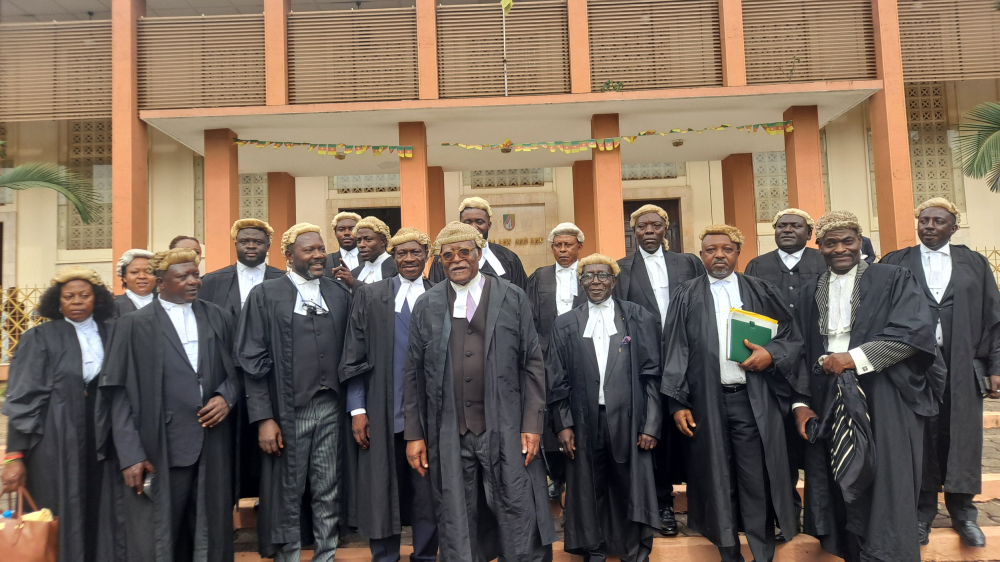
The second hearing in the appeal filed with the Supreme Court held on January 15, 2026. Ruling was fixed for March 19, 2026 for the appellants who were given life sentences in 2020.
January 15, 2026, Yaounde, Cameroon - The morning sun hung heavily over the verdant hills of Yaounde on Thursday, January 15, 2026, casting long shadows across the perimeter of the Supreme Court of Cameroon building. But within the precincts of the highest judicial authority in the land, the atmosphere was thick with anxiety, history, and the desperate weight of a crisis that has gripped the heart of the nation for nearly a decade.
VIP Prisoners
At 8:10 a.m., the ominous white mini-van, colloquially known as the “Black Maria,” rolled through the gates of the Supreme Court grounds. It carried 10 men who have become the symbols of the Anglophone Cameroon struggle - men whose fates now hang in the balance of a legal system that they argue has failed them at every turn. Escorted by prison warders and a phalanx of elite gendarmes, armed-to-the-teeth and bristling with automatic weaponry, the van was a stark reminder of the high security and the high stakes that defined the day’s proceedings.
Potpourri Of Backgrounds
Inside that vehicle were Julius Sisiku Ayuk Tabe, the self-proclaimed President of the Federal Republic of Ambazonia, and nine of his closest allies. They were not common criminals, in their own eyes or in the eyes of their supporters. They were teachers, lawyers, academics, and trade unionists. But to the State of Cameroon, they were terrorists, secessionists, and a threat to national unity.
The Justices, Counsel
On this day, they faced the second hearing of their appeal at the Supreme Court, a last-ditch effort to overturn life sentences and crippling fines that have effectively condemned them to die in prison. The Presiding Judge, Mrs. Justice Abomo Marie Louise, sat at the helm of a panel that included Mrs. Justice Ngo Mandeng Pauline Christine and Mr. Justice Eyango Rene Lucien. The state was represented by Advocate General Mr. Justice Eboua Henri. But the real gravity of the situation was felt in the silence of the accused, men who have spent years navigating the labyrinthine corridors of Cameroon’s military justice system.
As the giant doors to the court hall were flung open at 8:40 a.m., the 10 men waited outside, the final moments of anticipation ticking away before they would step once more into the arena that would decide their destiny.
The Context Of A Crisis
To understand the magnitude of January 15, 2026, one must rewind the tape to January 5, 2018. In a swift operation, 10 prominent Anglophone leaders were arrested in Nera Hotels, Abuja, Nigeria. And later transferred to Yaounde, Cameroon, a move their lawyers describe as a “gross violation of international law.”
Upon their arrival in Yaounde, they were thrust into the machinery of the Yaounde Military Tribunal. After spending time in the National Gendarmerie headquarters, SED. On August 20, 2019, after a trial that the defense argues was fraught with irregularities, they were slammed with life sentences. The charges were severe: terrorism, revolution, hostility against the homeland, secession, possession of firearms and military hardware…
Crippling Fines
The court did not stop there. It fined the 10 men a staggering 250 billion FCFA in damages and an additional 12 billion FCFA to cover trial expenses. The leaders appealed to the Court of Appeal for the Centre Region, but their hopes were dashed when that court upheld the military tribunal's ruling. Now, years later, the matter has finally reached the apex of the judicial pyramid in Cameroon - the Supreme Court. For the defense, this is not just an appeal; it is a fight for the soul of justice in Cameroon.
The Drama Of The Arraignment
The hearing on January 15, 2026, which finally commenced at 10:58 a.m., was marked by a rigorous procedural battle. At the heart of the defense’s argument was a fundamental question of fairness: were these men ever properly arraigned?
Barrister Eta Besong Junior, a former President of the Cameroon Bar Association and a towering figure in the legal team, rose to address the court. His voice was steady, his logic piercing. He drew the court's attention to a specific, glaring anomaly in the proceedings of the lower courts.
"We argued that only one of the 10 accused was arraigned by the Yaounde Military Tribunal - that is, the opportunity to plead guilty or not guilty at the start of their trial," Barrister Besong stated. "But it was never done."
Legal Arguments For….
Citing Articles 358 and 359(1) of the Criminal Procedure Code, Barrister Besong argued that the failure to arraign the other nine accused was not a mere technicality. It was a fatal flaw that nullified the entire trial. He pointed to the records of the military tribunal and the Court of Appeal, noting that the identity of the accused had not been verified before the trial proceeded.
"Our clients argue that the manner they were arrested in Nigeria and transferred to Cameroon was in gross violation of the law," Besong told the press later. "It is now left to the court to examine our arguments and make their decision. We can’t be counsel and judge over our own matter."
Point Of Correction!
The Advocate General, Mr. Justice Eboua Henri, countered that the matter at hand was the ruling of the Court of Appeal, not the initial trial. However, Barrister Besong was quick to dismantle this line of reasoning: "We cannot talk of the Court of Appeal ruling without mentioning the Yaounde Military Tribunal judgement because the former only adopted the ruling of the tribunal," Besong retorted. "The failure to arraign all 10 accused by the Yaounde Military Tribunal nullified their trial. The Supreme Court should therefore overturn the ruling of the Court of Appeal for the Centre Region, upholding the ruling of the Yaounde Military Tribunal," he pleaded.
Absence Of Jurisdiction?
The legal volley continued with Barrister Paddy Yong, the lead counsel for the appellants. He raised a chilling procedural point concerning the composition of the Court of Appeal that had previously upheld their sentences.
Barrister Yong highlighted Ground 6 of their appeal, which concerned two members of the Court of Appeal for the Centre Region. These judges, he argued, had been transferred by a presidential decree on August 10, 2020, yet they inexplicably remained seated on the bench during the appeal hearing on September 17, 2020. "This meant 'there was no court at all' because the court was not properly constituted," Barrister Yong submitted.
Attack On Foundation Of Case
But perhaps the most profound constitutional challenge was mounted by Barrister Wirgham Joseph Akuwiyadze. Addressing Ground 7 (e), Barrister Wirgham attacked the very foundation of the State’s case: the jurisdiction of the military court.
"Cameroon has ratified international conventions that bar military courts from hearing matters concerning civilians," Barrister Wirgham argued. He posited that these international statutes were superior in law to any local legislation that provided for the trial of civilians in military courts.
"Cameroon’s Anti-terrorism Law is therefore anti-constitutional and illegal against international conventions ratified by Cameroon," he declared. It was a bold assertion, challenging the Parliament’s legislation against the international treaties the State has signed.
The Weight Of The Rapporteur’s Report
The tension in the room spiked earlier in the morning when Mrs. Justice Ngo Mandeng Pauline Christine, the rapporteur, read the report prepared by the Supreme Court after studying the grounds of appeal. The report was a blow to the defense, dismissing six of the seven grounds of appeal as inadmissible in law.
The rapporteur argued that counsel for the appellants had failed to specify how the law was violated by the rulings of the lower courts. The reading ended at 11:42 a.m., setting the stage for the defense's spirited rebuttal.
Barrister Akere Muna, a legal luminary with decades of experience and a former President of the Cameroon Bar Association, brought his immense gravitas to the proceedings. He did not merely contest the report; he challenged the very narrative it presented.
Well Organised Hearing
"We were all witnesses to a court hearing that was very well organized and during which everyone was given their due respect. It was also bilingual," Muna acknowledged, showing respect to the bench. "However, we were all shocked that the rapporteur mentioned in her report that our clients were caught in possession of firearms, military equipment and fatigues, Indian hemp…"
Muna’s voice rose with incredulity as he painted a picture of the absurdity of the charges. "These people were arrested in Abuja, Nigeria and transferred to Cameroon. Who carried out the search? Of which premises, where and how? By the Nigerian police? This is ridiculous!"
Why These Huge Fines?
He turned his gaze to the astronomical fines, questioning the logic behind the 250 billion FCFA fines for damages. "The Yaounde Military Tribunal fined the 10 accused 250 billion FCFA and also fined them 12 billion FCFA for court expenses! Was it to prepare the grounds when Cameroon will be found guilty in the matter by an international court so that the cost will be offset? Were the fines realistic? On what where they based?"
Muna reminded the court of the jurisprudence of the Cour de cassation in France, which holds that if grounds for appeal are incorrectly stated, the court has an obligation to correct them, rather than punish the appellant.
"I reminded the court that the only thing prepares peace is justice. Without justice, it is difficult to attain peace," Muna said, his words hanging in the air like a solemn decree.
The Voices Of The Accused
Following the legal jousting, the Presiding Judge, Mrs. Justice Abomo Marie Louise, gave the appellants the opportunity to make their final statements. It was a moment of profound humanity amidst the cold machinery of the law. Julius Ayuk Tabe, the first respondent, stood to dissociate himself from the charges. His demeanor was calm but his words were cutting.
"I dissociate myself from charges of possession of firearms, Indian hemp, US military fatigues – things I have never seen in my entire life," he argued. Adding that such a charge was an affront to his children who have always seen him as a responsible father.
Procedural Void
Dr. Cornelius Kwanga, a man of science, brought the argument back to the procedural void. "I was never arraigned by the Yaounde Military Tribunal, and thus my life sentence and fine were null and void," Dr. Kwanga stated. "Does Cameroon respect international conventions?" he questioned as he ended his closing statement.
Professor Egbe Ogork, an Associate Professor of Structural Engineering, expressed the bafflement of the academic community. He wondered how an established university lecturer like him could suddenly be tagged a "terrorist." "I was picked up while on a trip to Abuja, Nigeria to see how we could help Cameroonian refugees. Only to be arrested and charged with terrorism!" Professor Ogork lamented.
Barrister Eyambe Elias, one of the legal minds among the accused, spoke of the language barrier that had plagued their trial. He argued that they were not given time to defend themselves and that the proceedings at the Military Tribunal were conducted in French, which many of them did not understand.
Language Barrier
Dr. Fidelis Nde Che echoed this sentiment. "I don’t understand French, yet my trial was held in French," he told the court. "I faced a jury who all spoke French and no English,” saying as a result, “justice was not done."
Professor Kimeng Henry Tata, another Associate Professor of Structural Engineering, recalled his years as President of the Cameroon Students’ Union in Nigeria. He spoke of his services to the country, contrasting it with the charge of terrorism that now defined his existence. "Let the Supreme Court render justice," he pleaded.
Dr. Nfor Ngala Nfor, the eldest of the appellants and Secretary General of the Southern Cameroons National Council (SCNC), provided the historical context that has fueled this conflict. He spoke of a movement that has always fought for peaceful self-determination for the peoples of the former British Southern Cameroons, as provided for in international law.
Work Continues In Prison
Augustine Che Awasum, an Associate Professor of Veterinary Surgery, recounted the humiliation of his arrest in Abuja and his transfer to Yaounde. Despite his imprisonment, he highlighted his resilience and dedication to his craft, disclosing that while in prison, he has already supervised three PhD and two Master’s theses.
Barrister Shufai Blaise delivered a scathing indictment of the process. "The abduction, detention, trial and sentencing to life imprisonment was void of justice," he argued. He pointed out that when their lawyers abandoned them during the trial, the military tribunal refused them time to find new counsel.
Role Of Teachers’ Union
Finally, Mr. Tassang Wilfred, the former teachers’ trade union leader, took the floor. His speech was a poignant reminder of the origins of the Anglophone crisis - the "Anglophone Problem" that predates the armed conflict. He revisited his trade union activism, explaining that the strike actions were born out of a desperate need to fix the education system. He spoke of Anglophone children in technical colleges being taught by Francophone teachers who understood little English.
"Repeatedly, Tassang asked: 'If asking for better education for Anglophone students is terrorism, then I submit am a terrorist,'" the court recorded.
Example Of Bakassi
Mr. Tassang appealed to the Supreme Court’s sense of history and duty. "The Supreme Court of Cameroon has the singular opportunity to rebrand Cameroon. Cameroon took Nigeria to the International Court of Justice over the Bakassi Pensinsula and won. Cameroon should therefore have no problem respecting international law."
He reminded the bench of the 2009 ruling by the African Commission on Human and People’s Rights in Banjul, The Gambia - a ruling that remains a touchstone for the Anglophone grievances.
The Prosecution’s Stand
In response to the defense's barrage, the counsel for the State of Cameroon, Maitres Martin Luther King Achet Nagnigni and Mandeng Alexandre Parfait, offered a different narrative. They argued that the disruption of the initial trial by the accused – specifically by singing and making the environment rowdy - was the reason why all 10 were not formally arraigned.
Advocate General Eboua Henri supported the view that the transfer of judges did not invalidate the Court of Appeal's s...
Cet article complet est réservé aux abonnés
Déjà abonné ? Identifiez-vous >
Accédez en illimité à Cameroon Tribune Digital à partir de 26250 FCFA
Je M'abonne1 minute suffit pour vous abonner à Cameroon Tribune Digital !

- Votre numéro spécial cameroon-tribune en version numérique
- Des encarts
- Des appels d'offres exclusives
- D'avant-première (accès 24h avant la publication)
- Des éditions consultables sur tous supports (smartphone, tablettes, PC)







Commentaires