
Shovels, Stethoscopes, And Solidarity: Equipping Cameroon’s Youth For Tomorrow’s Storms
- Par Kimeng Hilton
- 20 Jan 2026 21:56
- 0 Likes
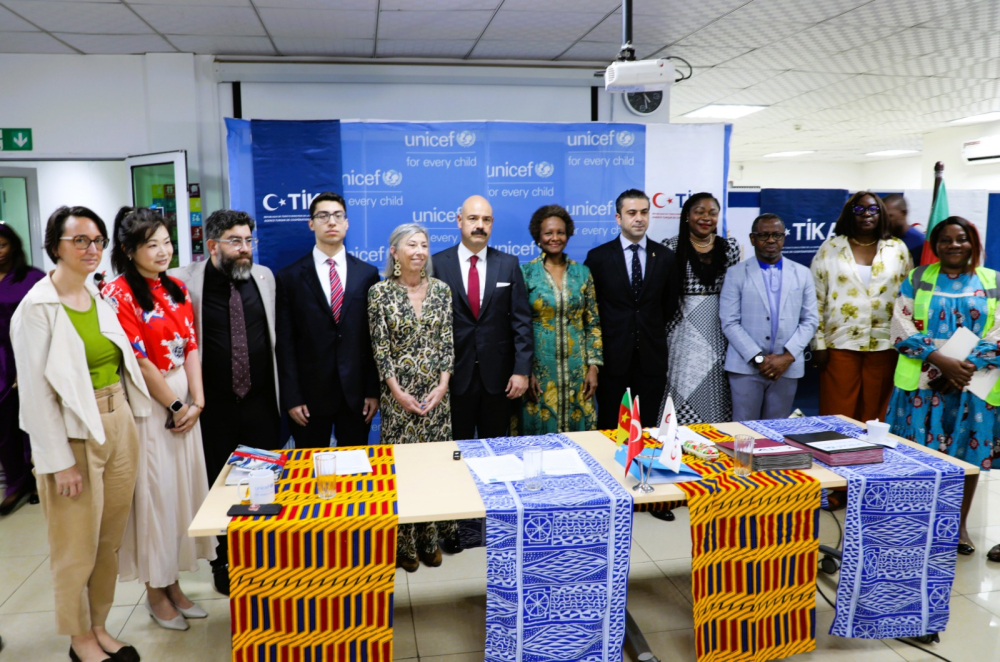
The United Nations Children’s Fund, UNICEF and the Turkish Cooperation and Coordination Agency, TİKA on January 20, 2026 in Yaounde signed a Memorandum of Understanding, MOU.
The humid air of Yaounde hangs heavy with possibility, a tangible weight that matches the gravity of the documents being exchanged across the polished table. In a city that has long served as the diplomatic heartbeat of Central Africa, a new rhythm is being struck.
It is a rhythm that blends the logistical precision of the Turkish Cooperation and Coordination Agency, TİKA with the humanitarian mandate of the United Nations Children’s Fund, UNICEF.
Memorable MoU
On this day, January 20, 2026, the two entities signed a Memorandum of Understanding, MoU that is as ambitious in its scope as it is practical in its application. It is a partnership designed not just to alleviate suffering, but to fundamentally alter the architecture of resilience in Cameroon.
For an initial period of two years, these two organizations will combine their expertise, networks, and resources to support the most vulnerable children and young people in regions battered by humanitarian crises and the accelerating violence of climate change.
Convergence Of Philosophies
But to view this merely as the signing of paperwork is to miss the "new frontier" that Melih Çağatay Artunay, TİKA’s Cameroon Programme Coordinator, so passionately described. This agreement represents a convergence of philosophies - a marriage of the "active solidarity" championed by the Republic of Türkiye and the global, rights-based advocacy of the United Nations.
It is a project protocol that aims to move mountains, or as the Turkish proverb cited by Artunay suggests, “to place enough hands on the heavy stones of precariousness such that the burden becomes liftable.”
The Anatomy Of A Crisis
To understand the significance of this partnership, one must first understand the context into which it lands. Cameroon is a nation of stark contrasts and immense pressures. In the Far North, the scourge of insurgency and environmental degradation has displaced thousands, leaving communities fragmented.
In the North West and South West Regions, conflict has disrupted education and social services. Simultaneously, climate change is no longer a distant threat; it is a daily reality. From the drying lake beds to the flooding coastal plains, the environmental shocks are eroding the capacity of communities to survive.
Upsetting Traditional Aid Model
Traditional models of humanitarian aid have often operated on a "top-down" basis. International agencies arrive, deliver supplies, and leave. While essential, this model often fails to build the kind of long-term muscle memory required for a community to withstand the next shock.
The UNICEF-TİKA protocol therefore seeks to disrupt this cycle. It identifies the weakest links in the chain - children and young people - and resolves to turn them into the strongest. The agreement places a fierce emphasis on the concept of "youth engagement." This is not about viewing youth as passive beneficiaries of aid, but as active agents of change, as first responders, and as the architects of their own future.
From Beneficiary To Responder
At the heart of this two-year agenda lies the U-Report and U-Responders initiative. Led by UNICEF, U-Report is a digital tool that has been mobilizing youth across the globe. In Cameroon, under this new agreement, it is set to evolve into a ground-level force for emergency response.
The details of the MoU reveal a strikingly practical approach to empowerment. The agreement outlines concrete actions to strengthen the capacities of U-Reporters through rigorous training. We are not speaking here of theoretical workshops. We are talking about disaster management, child rights, and critical First Aid skills. Specifically, the protocol calls for training in Cardiopulmonary Resuscitation, CPR, hemorrhage control, and fracture management.
Huge Sustainability Implications
Consider the implications of this. In a remote village where the nearest clinic is hours away, a young person equipped with the knowledge to stop a massive bleed or stabilize a fracture becomes a lifeline. This training decentralizes survival. It places the power to save lives directly into the hands of the community.
Nadine Perrault, the UNICEF Representative in Cameroon, captured the essence of this shift during the signing ceremony. "Through initiatives such as U-Report and U-Responders, young people are not only beneficiaries, but active contributors to solutions at the community level," she stated. This transition from beneficiary to contributor is the psychological key to sustainable development. It restores agency to those who have been marginalized by conflict and poverty.
Shovels, Wheelbarrows, Resilience
However, training alone is insufficient without the tools to act. The protocol is refreshingly specific about the material support that will be provided. The agreement lists equipment that sound modest, but carry immense functional weight: shovels, wheelbarrows, boots, gloves, watering cans, and First Aid kits.
These items tell a story of environmental stewardship and community service. They paint a picture of young people donning boots and gloves to clear drainage canals before the rainy season. Thereby preventing the floods that so often wash away homes and livelihoods. They envision U-Reporters using wheelbarrows and watering cans to plant trees and combat erosion, turning the tide against desertification.
Practical Implementation
This is the "implementation-oriented" cooperation that His Excellency Volkan Oskiper, the Turkish Ambassador to Cameroon, emphasized in his remarks. "At TİKA, our work in Cameroon is guided by local needs, field realities, and sustainability," the Ambassador noted. He explicitly stated that the objective is not "short-term visibility," but "long-term, sustainable impact." There is no glory in a shovel, but there is dignity in the work it enables, and there is resilience in the drainage it digs.
The "Golden Age" Of Diplomacy
While the operational aspects of the partnership are grounded in mud and concrete, the diplomatic atmosphere in Yaoundé is soaring in what TİKA’s Artunay described as a "Golden Age." The speeches at the signing ceremony revealed a deepening bond between the Republic of Türkiye and the Republic of Cameroon, a relationship that has expanded far beyond mere diplomatic niceties.
Artunay spoke with profound emotion about this "new frontier" in commitment. He positioned the partnership as an "alliance of both heart and mind," a meeting point between the global expertise of the UN and the "vision of active solidarity" championed by Türkiye. His rhetoric was not empty flourish; it was backed by a track record of Turkish involvement in the region.
New Corridors Of Cooperation
He described "corridors" of cooperation that are reshaping the relationship between Ankara and Yaounde. There is the economic corridor, where Turkish companies are building iconic infrastructure; the educational corridor, paved with scholarships and schools; and the healthcare corridor, supported by mobile clinics and medical equipment. The signing of the protocol with UNICEF adds a fourth, critical corridor: the humanitarian and resilience corridor. It situates child protection at the very apex of this bilateral relationship.
Diversified Cooperation
"The dialogue between Ankara and Yaounde is now unfolding at the highest levels of State," Artunay reminded the audience. "This brotherhood can be felt in every corridor." He pointed to the recent allocation of strategic land for Turkish representations and the increase in ministerial exchanges as testament to this mutual trust. "Türkiye does not see Cameroon as a mere partner, but as a strategic brother at the heart of Africa," he affirmed.
Support For SND30
This geopolitical backing is crucial. It ensures that the UNICEF-TİKA projects are not isolated islands of aid, but are integrated into a broader national strategy. As Artunay highlighted, for the Cameroonian government, this partnership offers solid support for the National Development Strategy, SND30. It is an acknowledgement that Cameroon’s development must be driven by Cameroonians themselves, supported - but not dictated - by international partners.
Beyond The Cheque Book
One of the most compelling aspects of the partnership is the methodology that TİKA brings to the table. In an era where development aid is often reduced to financial transfers, Artunay stressed that TİKA brings something different. "TIKA does not only bring funds; it brings a development methodology based on sharing experience and technology transfer," he explained.
This philosophy aligns perfectly with the UNICEF mandate of capacity building. It creates a multiplier effect. When you build a school, you educate a generation. But when you transfer the technology and the expertise to build and maintain that school, you educate generations.
Involving Private Sector
The agreement also outlines a plan to "Integrate child rights into the policies and standards of companies and institutions." This involves developing tailored guides and training modules. It is an attempt to weave child protection into the very fabric of the private sector. By engaging Turkish companies operating in Cameroon and the Cameroonian Diaspora,...
Cet article complet est réservé aux abonnés
Déjà abonné ? Identifiez-vous >
Accédez en illimité à Cameroon Tribune Digital à partir de 26250 FCFA
Je M'abonne1 minute suffit pour vous abonner à Cameroon Tribune Digital !
- Votre numéro spécial cameroon-tribune en version numérique
- Des encarts
- Des appels d'offres exclusives
- D'avant-première (accès 24h avant la publication)
- Des éditions consultables sur tous supports (smartphone, tablettes, PC)





Commentaires