
The Bitter Truth Of Sweetness: Cameroon’s Fight For Healthy Food Policies
- Par Kimeng Hilton
- 25 Jan 2026 21:37
- 0 Likes
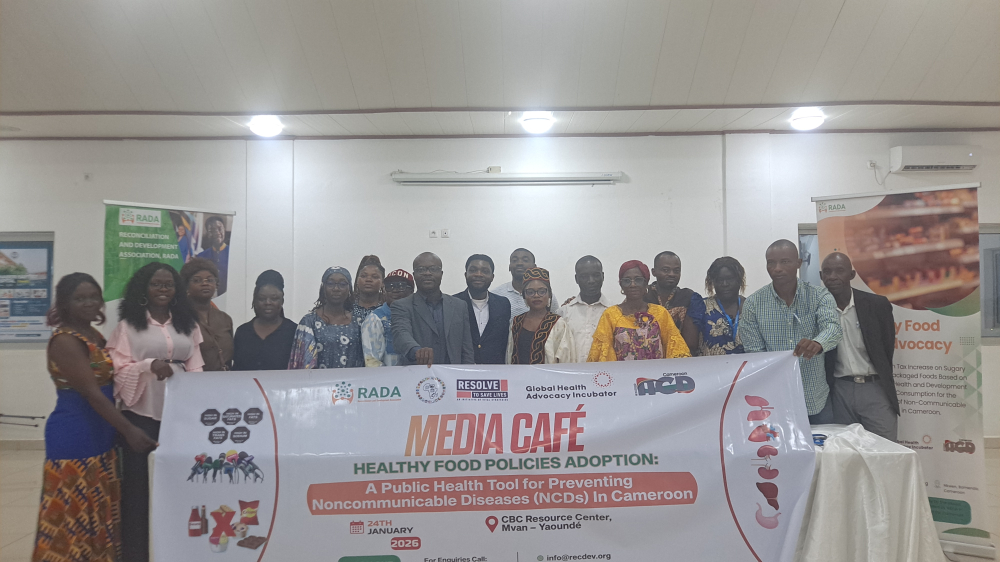
Reconciliation and Development Association, RADA Cameroon and the African Media Network for the Promotion of Health, Environment, Gender, and Human Rights, REMAPSEN, briefed the media in Yaounde on January 24, 2026.
The humid air of Yaounde hung heavy with a sense of urgency on Saturday, January 24, 2026. But it was not the weather that had gathered the nation’s most astute minds in media and civil society under one roof. Inside the conference hall of the Cameroon Baptist Convention, CBC Resource Centre, Mvan, Yaounde, the atmosphere was charged with a different kind of heat. The burning necessity to address a silent epidemic creeping through the veins of the nation. It was a "Media Café," a gathering not to sip fine brews, but to distill the bitter truth about what Cameroonians consume.
Time Is Up!
The Reconciliation and Development Association (RADA Cameroon), in strategic partnership with the African Media Network for the Promotion of Health, Environment, Gender, and Human Rights (REMAPSEN), had convened this briefing. Their message was stark, their evidence overwhelming, and their demand clear: The time for passive consumption is over. Cameroon stands at a precipice, and the path forward requires a radical rethinking of how food is produced, marketed, and consumed.
At the heart of this clarion call is a battle against Non-Communicable Diseases (NCDs) - the silent, chronic killers that now claim more than 43% of all deaths in the country annually. As the speakers took the stage, supported by the technical and financial might of Resolve to Save Lives and the Global Health Advocacy Incubator (GHAI), the narrative shifted from simple health advice to a sophisticated policy demand: Front-of-package warning labels and health taxes on unhealthy foods.
The Silent Killer At The Dinner Table
For decades, the Cameroonian health narrative was dominated by infectious diseases. But as the sun set on the era of communicable dominance, a new, insidious dawn broke. In 2016, a pivotal shift occurred. Unhealthy diets dethroned tobacco as the number one risk factor for NCDs. Today, the landscape of public health is scarred by cardiovascular diseases, diabetes, obesity, cancer, and chronic respiratory diseases.
Prince Mpondo, the National Coordinator of REMAPSEN Cameroon, stood before the assembled journalists, his demeanor a mix of gravitas and resolve. He spoke of a crisis that is invisible until it is too late. "Non-communicable Diseases are now on the rise – thus a public health issue," Mpondo declared. He painted a picture of a nation that is literally eating itself into sickness, unaware that the daily sprinkling of salt or the indulgence in sugary drinks is a slow-acting poison.
Media’s Great Place
"The media has a great role to play in sensitizing the public on unhealthy foods," Mpondo urged. His words were not just a request; they were a strategy for survival. He highlighted a simple yet ignored fact: a person should consume at most a teaspoonful of salt in all their meals per day. Yet, stroll through any market in Douala or Bamenda, watch the street food vendors, and it becomes evident that this limit is being shattered daily.
The economic argument was equally compelling. "Failure to live healthily means spending much more on medication when you fall sick," Prince Mpondo warned. It is a cycle of poverty - poor diet leads to poor health, which drains the pockets of families and the resources of the State. In a country striving for development, this burden is a drag on progress.
New Generation Of Unrecognizable Products
Taking the podium next was Mbiydzenyuy Ferdinant Sonyuy, the founder and Chief Executive Officer of RADA Cameroon. Sonyuy’s presentation was a masterclass in public health advocacy, blending hard data with a philosophical appeal to the nation’s conscience. He began by acknowledging the media’s pivotal role, not just as reporters, but as "awareness creators and advocates."
Sonyuy introduced the audience to the enemy: ultra-processed packaged food products. These are not the foods of our ancestors. "In 2026, we now see new kinds of products that our grandparents and parents can testify that they no longer recognise," Sonyuy noted. He described them with vivid detail - their various artificial colours, their engineered tastes, and their devastating effects on the human body.
Alarming Data
The data Sonyuy presented was alarming. A systematic review by Nansseu JR in 2019 revealed that 26% of Cameroonian adults are overweight, while 15.1% fall into the category of obesity. But the most heartbreaking statistic concerns the children. The prevalence of overweight in children under five has almost doubled, rising from 5% in 1991 to 11% in 2018. In urban areas, 12.5% of children aged 3 to 13 are considered overweight, with girls (13.2%) being more affected than boys (11.8%).
This is not just a health statistic; it is a demographic time bomb. These children, facing a lifetime of chronic illness, represent the future workforce of Cameroon. Their health is the nation's wealth, and currently, that wealth is being eroded by high-sugar, high-salt, and high-fat snacks.
Sonyuy issued a proverbial warning that resonated through the hall: "What is sweet in the mouth is not often healthy to the body and what is healthy for the body is not often sweet to the mouth." It was a call to reset the palate of the nation, to embrace the bitter greens and whole grains that sustain life over the sugary rush that shortens it.
Labels That Speak
The core of the Media Café’s agenda was the promotion of specific, evidence-based policies to combat this crisis. The advocates were not asking for vague "healthy eating" campaigns; they were demanding regulatory teeth. The two primary interventions discussed were front-of-package warning labels and marketing restrictions, alongside health taxes.
Currently, when a Cameroonian mother picks up a juice box or a packet of biscuits for her child, she is often met with a confusing array of nutritional information on the back - small print, percentages, and scientific jargon that requires a degree in nutrition to decipher. This lack of transparency is what the proposed "Front-of-Package Warning Labels" aim to fix.
More Than Labels
Imagine a simple black stop sign, an octagon, or a bold icon on the front of the package screaming: "High in Sugar" or "High in Sodium." This is not just a label; it is a shield. It cuts through the marketing noise and tells the consumer the truth in a split second. Mbiydzenyuy Sonyuy explained that these labels serve as a strategic tool recommended by the World Health Organization (WHO) as a "best buy" for 2030 strategic interventions.
"Front-of-package warning labels serve as a strategic and essential tool for this response," Sonyuy emphasized. "They also create a strong foundation for other interventions once implemented, such as easing marketing restrictions to encourage the industry to reformulate products with excess amounts of the nutrients of health concern."
Oblige Them To….
The logic is elegant: shame and science together drive change. When a manufacturer is forced to put a large black warning label on their product, sales inevitably drop. To survive, the manufacturer is incentivized to "reformulate" the product - to lower the salt, sugar, and fat content to avoid the warning label. This has been proven in countries like Chile, where such labels have led to a measurable decrease in the consumption of sugary drinks and processed snacks.
Taxation On Health
However, education and labeling alone may not be enough to break the addiction to unhealthy food. This is where the second pillar of the advocacy comes in: Health Taxation. The proposal suggests levying a tax on products produced by companies that are harming the health of the population.
This concept often faces resistance, but Sonyuy was quick to clarify its purpose. "Taxation, as a measure, is not meant to increase prices for the sake of increasing them, but to reduce consumption of unhealthy products by making the products that qualify for taxation unaffordable due to their potential health harms."
Curbing Abusive Consumption
It is a double-edged sword against NCDs. First, the higher price discourages purchase, particularly among price-sensitive youth and low-income families who are most at risk. Second, the revenue generated can be reinvested into the healthcare system or used to subsidize healthy fruits and vegetables, making nutritious food accessible to all.
Sonyuy warned of a "double jeopardy" if action is not taken. "We must not only increase our attention to healthy options, but we must run away from unhealthy options if we don't want to be caught up by their high prices and negative impacts." In other words, either the consumer pays now for healthy food, or they pay later with their lives and their savings on medical bills.
The Role Of The Fourth Estate
The "Media Café" was not named by accident. It recognized that the media is the "café" of society - the place where ideas are brewed, debated, and served to the public. The organizers stressed that the media is not just a mirror reflecting society, but a hammer with which to shape it. "We wish to empower individuals to take control of their health and make choices that align with their wellbeing, and we definitely believe that you will take this message across," Sonyuy told the journalists. He appealed to them to become "active allies" in the fight.
The press has the power to connect decision-makers with the harsh realities of the population. They can amplify the prevention efforts of stakeholders and ensure that the government's authority is not "influenced by the companies that produce and sell these products." In the battle against big food corporations, the pen - and the microphone - is indeed mightier than the sword.
Guarding The Government’s Autonomy
A significant portion of the briefing was dedicated to the political economy of food policy. Sonyuy made a passionate plea to safeguard the autonomy of the government. "We must therefore not allow the authority, responsibility and autonomy of the government to be influenced by the companies that produce and sell these products to the population."
The food industry is wealthy and influential. They have the resources to lobby against these policies, to fund counter-studies, and to delay legislation. The Civil Society Organizations (CSOs) present at the event positioned themselves as a buffer, a force that amplifies the public's voice against corporate interests.
Kudos To MINSANTE!
The organizers appreciated the Minister of Public Health, Dr. Manaouda Malachie, and his team for their resilience and professionalism. They noted the development of the nation's action plan for the promotion of healthy diets, which includes the taxation perspective. However, a plan on paper is not enough; it must be implemented. The rallying cry was to bring the public along, to foster a groundswell of support that makes it politically impossible for the government to back down.
From Rural To Urban
One of the most insightful aspects of the presentation was the breakdown of sugar consumption across different demographics. A landscape analysis of sugar consumption in Cameroon revealed surprising trends. It is often assumed that urban areas, with their supermarkets and fast-food chains, are the sole hotspots for unhealthy eating.
However, the research suggested that rural Cameroonians, both men and women, tend to have higher energy intakes than commonly reported. This points to a possible underestimation of their sugar consumption. Among the rural population, individuals aged 20 to 39 often exhibit poor dietary habits, including elevated sugar intake.
Shattered Myth
This data shatters the myth that this is solely an "urban elite" problem. The NCD crisis is reaching the furthest corners of the country. Therefore, the advocacy must also reach these rural communities. The media was challenged to take the message from the urban centres to the rural heartlands. To educate every citizen, regardless of their location, on the risks of what they eat.
Don’t Close Your Eyes!
Perhaps the most poignant moment of the event came with the unveiling of the campaign slogan: "When you open your mouth, don’t close your eyes." It is a powerful metaphor for mindful consumption. In a fast-paced world, we often eat on the go, distracted by our phones, our work, or our worries. We shove food into our mouths while our "eyes" are closed to the consequences.
The campaign literature distributed at the event was a treasure trove of information designed to pry open those eyes: Did You Know? Unhealthy diets are those that have excess amounts of sugars, salt, saturated and trans-fats. Did You Know? Many packaged food products contain nutrients in amounts that can be dangerous to your health. Did You Know? NCDs are silent in nature, difficult to treat, and often lifelong.
The materials also highlighted the grim reality of the numbers. Between 2010 and 2018, annual deaths in Cameroon from NCDs rose from 31% to 38%. About 18,000 people die every year in Cameroon from diet-related risks. These are not just numbers; they are fathers, mothers, brothers, and sisters.
Global Movement With Local Roots
Importantly, the Media Café highlighted that Cameroon is not fighting this battle alone. The presentation on countries that have successfully implemented front-of-package labeling: Belgium, Bulgaria, Canada, Denmark, Finland, Germany, Israel, and several others.
Cameroon is poised to join this vanguard. The speaker noted, "Cameroon will be one of the first countries to do so in Africa to help protect its population." Ethiopia, Ghana, and South Africa are already working on their labels. There is a continental shift towards recognizing the right to healthy food as a fundamental human right.
Broader Look
This global perspective is crucial. It counters the argument that such policies are anti-business or Western imports. On the contrary, they are global best practices for development. The support from Resolve to Save Lives and GHAI underscores the international community's commitment to helping Cameroon navigate this transition.
Resolve to Save Lives, a not-for-profit organization partnering with countries to prevent 100 million deaths from cardiovascular disease, brings technical expertise. Meanwhile, GHAI supports civil society organizations worldwide in using the power of advocacy to save lives. Their vision is a healthier and more equitable future for all.
About The Architects Of Change
The driving forces behind this initiative are organizations deeply embedded in the Cameroonian fabric. RADA Cameroon (The Reconciliation and Development Association) is a nonprofit organization that seeks to support inclusive community development. Their domains are vast: Health, Education, Agriculture, Technology, Sustainable Peace, and Environmental Protection. By leading this charge, RADA is living up to its name - bridging the gap between current realities and a sustainable future.
REMAPSEN (The African Media Network for the Promotion of Health, Environment, Gender, and Human Rights) represents the Fourth Estate’s commitment to social good. By co-organizing the event, they reinforced the idea that journalists are not just observers but active participants in the nation's development.
Déjà abonné ?
Identifiez-vous >
Cet article complet est réservé aux abonnés
Accédez en illimité à Cameroon Tribune Digital à partir de 26250 FCFA
Je M'abonne
1 minute suffit pour vous abonner à Cameroon Tribune Digital !



Reactions
De la meme catégorie


En kiosque



Commentaires