

Navigating The Human Tide: The Quest To Align Human Mobility With National Development
- Par Kimeng Hilton
- 23 Feb 2026 13:51
- 0 Likes
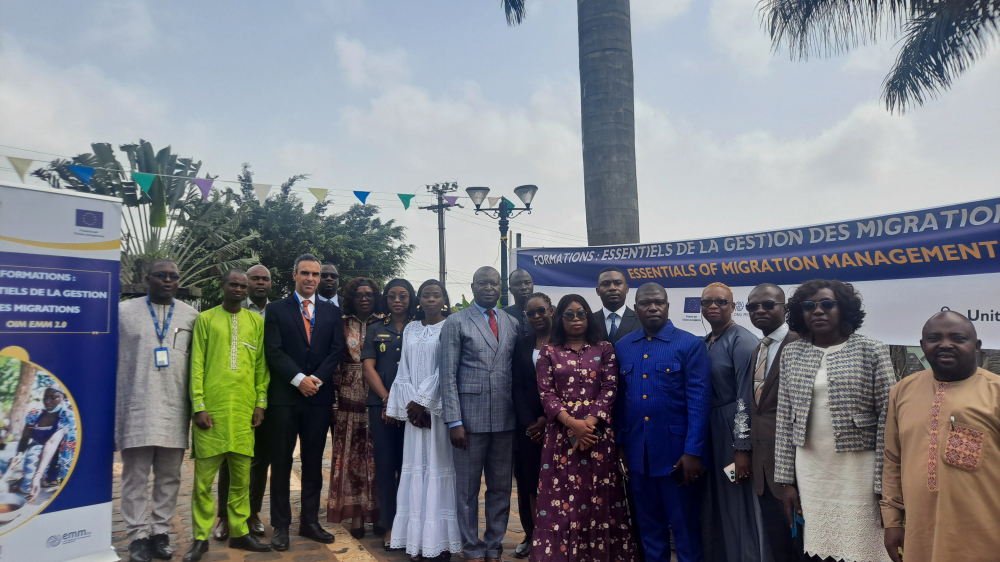
The International Organization for Migration, IOM and the Cameroon Ministry of External Relations, MINREX on February 23, 2026 began training on migration management. The workshop in Mbankomo, near Yaounde, is supported financially by the European Union.
In the quiet town of Mbankomo, on the verdant outskirts of Cameroon’s bustling capital, Yaounde, a five-day gathering of profound significance opened on Monday, February 23, 2026. While the location is peaceful, the subject matter at hand is as turbulent and dynamic as the currents of the Atlantic Ocean - the movement of people.
Call To Action
The International Organization for Migration, IOM, in steadfast partnership with the Cameroon Ministry of External Relations, MINREX and with the generous financial support of the European Union, EU Delegation in Cameroon, has convened a pivotal workshop titled “Essentials of Migration Management OIM EMM 2.0” - holding in two phases from February 23-27, 2026. It is not merely a meeting; it is a call to action for a nation standing at the crossroads of displacement, opportunity, and survival.
Strengthening Government’s Capacities
Joaquim Torrinha, the Head of Programmes for IOM Cameroon, stood before a room with high-level government officials, legal practitioners, and technical partners. His words set the tone for the days to come. "The importance of this workshop," Torrinha began, "lies in its capacity to reinforce the abilities of each government to put forth an efficient migration governance."
“Essentials of Migration Management” training is a global IOM initiative, implemented annually in various corners of the world. However, in Cameroon, its resonance is unique. Here, migration is not an abstract statistic; it is a daily reality shaped by conflict in the Far North, instability in the North West and South West, and the creeping, silent threat of climate change.
Increase In Knowledge
As Torrinha noted, the training touches upon a diversity of subjects - return migration, re-admission, the protection of vulnerable migrants, and the symbiotic relationship between migration and development. "At the end of the training, what do we want?" Torrinha asked the room. "The expected change is exactly an increase in knowledge."
But beyond knowledge, the expectation was a shift in perspective - a move toward a "whole-of-government" approach where migration is not the sole purview of a single ministry, but a central pillar of national strategy.
The Complex Tapestry Of Cameroonian Mobility
To understand the urgency of the EMM 2.0 workshop, one must first understand the complex mosaic of human mobility in Cameroon. The country currently faces a sophisticated mix of displacement, cross-border flows, outward migration, and growing remittance inflows. These dynamics are driven by a "poly-crisis" environment: the insurgency in the Far North, the protracted Anglophone Crisis, regional displacement, and severe climate stress on livelihoods.
According to data presented during the workshop, Cameroon hosts large numbers of Internally Displaced Persons, IDPs, with humanitarian reporting indicating that several hundred thousand to over two million people are currently in need of assistance. Displacement has sharpened in recent years, fueled by conflict and insecurity. Yet, the picture is more nuanced still.
High Urbanisation Rate
Cameroon is experiencing one of the highest rates of urbanization in Sub-Saharan Africa, with 56% of the population now living in cities. This urban drift is driven by the "pull factors" of better economic opportunities, but it also creates immense pressure on urban infrastructure, leading to the proliferation of informal settlements where services are scarce.
The cross-border dynamics are equally intricate. Significant movement occurs between Cameroon and Nigeria, while the East and Adamawa Regions continue to host refugees fleeing instability in the Central African Republic, CAR. According to the UN Department of Economic and Social Affairs (2025), Cameroon has seen a steady increase in international migration flows from 2010 to 2024. In 2010, the stock of international migrants in Cameroon was 990,500, representing 1.5% of the total population. That number has since risen.
The Diaspora Dividend: An Underutilized Engine
While the challenges of displacement and influx are palpable, the workshop seeks to highlight a massive, often underutilized asset - the Cameroonian diaspora. There are currently around 6 million Cameroonian nationals living in five continents, with a high concentration in Africa. This represents nearly 15% of the country's total population. "They contribute more than 1% of GDP through remittances to their families," the workshop context report notes. In 2024 alone, Cameroonians abroad transferred $603 million (over CFAF 362 billion).
Required Financial Resources
However, as Joaquim Torrinha and the IOM experts emphasize, the mobilization of these financial resources remains suboptimal. "Although considerable, these financial flows remain underutilized in relation to their potential," the report states.
The vision being articulated in Mbankomo is clear: Cameroon must move from viewing remittances merely as family support to seeing them as catalyst for local economic resilience and recovery. By formalizing remittance channels and integrating migration into development planning, the country can boost financial inclusion and fund local infrastructure.
The Humanitarian-Development-Peace Nexus
A central theme of the workshop is the "HDP Nexus" - the recognition that humanitarian aid, development, and peacebuilding are not sequential stages, but concurrent necessities. In 2025, Cameroon continued to grapple with a protracted humanitarian crisis driven by three concurrent emergencies: the Lake Chad Basin conflict, the Anglophone Crisis, and the refugee presence from the CAR. Conflict and violence have interacted with climate shocks and recurrent disease outbreaks, leaving an estimated 3.3 million people in need of humanitarian assistance and protection. Among them, large numbers of children, with girls representing over 50%, are disproportionately affected.
Addressing Root Causes
The training curriculum seeks to drive home the point that effective migration governance must address the root causes of irregular migration: marginalization, weak governance, and a lack of livelihoods. "Addressing key drivers of irregular migration and investing in durable solutions for IDPs and returnees are critical to prevent cycles of displacement and insecurity," the curriculum notes.
The Legal Architects
The first two days of the workshop, February 23 and 24, 2026, are dedicated to the legal architects of Cameroon’s migration policy. Targeting legal advisers from the Ministry of Justice, External Relations, Territorial Administration, and border-related institutions, this session was designed to "enhance and strengthen legal and institutional capacity on migration law, Return, Readmission, Reintegration (RRR) frameworks, and legally-sound Standard Operating Procedures (SoPs)."
Led by a roster of distinguished experts, including Prof. Abdou Khadre Diop, President of the Network of Legal Experts on Migration for West and Central Africa, and Dr. Christian Angue, a national expert, the participants dove deep into the "Essentials of Migration Management: Core Concepts."
Legal Framework
The discussions were rigorous. On the first day, the participants dissected international legal instruments, African Union (AU) and Economic Community of Central African States (ECCAS) obligations, and bilateral agreements. The tension between national sovereignty and regional commitments was explored, particularly regarding the free movement of persons.
A highlight was the session on the "National legal frameworks on migration," led by Dr. Angue. This session was crucial for identifying gaps between domestic legislation and international standards. Participants engaged in a "Migrants’ human rights" activity, designed to humanize the legal jargon and remind the practitioners that behind every case file is a human being entitled to dignity.
Upon Return
The second day of the legal session will tackle the sensitive subject of "Return, Readmission and Reintegration." Led by Corantine Groccia and Dr. Angue, the session will examine the legal value of Standard Operating Procedures, accountability mechanisms, and coordination.
"Readmission agreements require a delicate balance of due process and safeguards," Groccia emphasized earlier. The legal practitioners are expected to be tasked with analyzing the "Role of the State on legal aspects of return," ensuring that the State's right to control its borders does not infringe upon the rights of the individuals returning.
Fragile Context Response Possibilities
The session will conclude with a look at "Legal responses in fragile contexts," led by Michele W. Nyamokami. Here, the focus will shift to balancing security imperatives with protection and development.
How does a State enforce the law in regions where governance is fractured by conflict? The group work on "Case studies on the violation of migrant human rights" will provide a sobering reality check, forcing participants to confront the legal failures that can occur in times of crisis.
The Governmental Symphony
Following the intense legal groundwork, the workshop will expand from February 25 to 27, 2026 to include a broader array of government officials. If the first session will be on the rules, the second session will be on the strategy. Joaquim Torrinha will return to lead the opening session on "Essentials of Migration Management: Core Concepts and key migration trends in Cameroon." This time, the audience is expected to be wider - representatives from labour, social protection, and local authorities. The objective is to break down the silos that often plague government administration.
The "Whole-of-Government Approach" is a concept that sounds simple in theory, but is difficult in practice. It requires the Ministry of Trade to understand the implications of visa policies. The Ministry of Health to understand the epidemiological risks associated with cross-border movement. And the Ministry of Territorial Administration to coordinate with the Ministry of Social Affairs on the protection of vulnerable migrants.
Managing Migration, The Policy
A key component of this session will be "Migration Management and the Policy Cycle," led by Prof. Diop and Edlira de Andres. Participants will be guided through the intricacies of policy formulation, implementation, and evaluation. The interactive group work will focus on "Mapping migration responsibilities by institution," a practical exercise that is expected to reveal overlapping mandates and, crucially, the gaps where no ministry was taking ownership.
The subsequent days will focus heavily on the operationaliz...
Cet article complet est réservé aux abonnés
Déjà abonné ? Identifiez-vous >
Accédez en illimité à Cameroon Tribune Digital à partir de 26250 FCFA
Je M'abonne1 minute suffit pour vous abonner à Cameroon Tribune Digital !

- Votre numéro spécial cameroon-tribune en version numérique
- Des encarts
- Des appels d'offres exclusives
- D'avant-première (accès 24h avant la publication)
- Des éditions consultables sur tous supports (smartphone, tablettes, PC)







Commentaires