

New Legal Chapter: Supreme Court Orders Fresh Hearing For Imprisoned Separatist Leaders
- Par Kimeng Hilton
- 19 Mar 2026 18:06
- 0 Likes
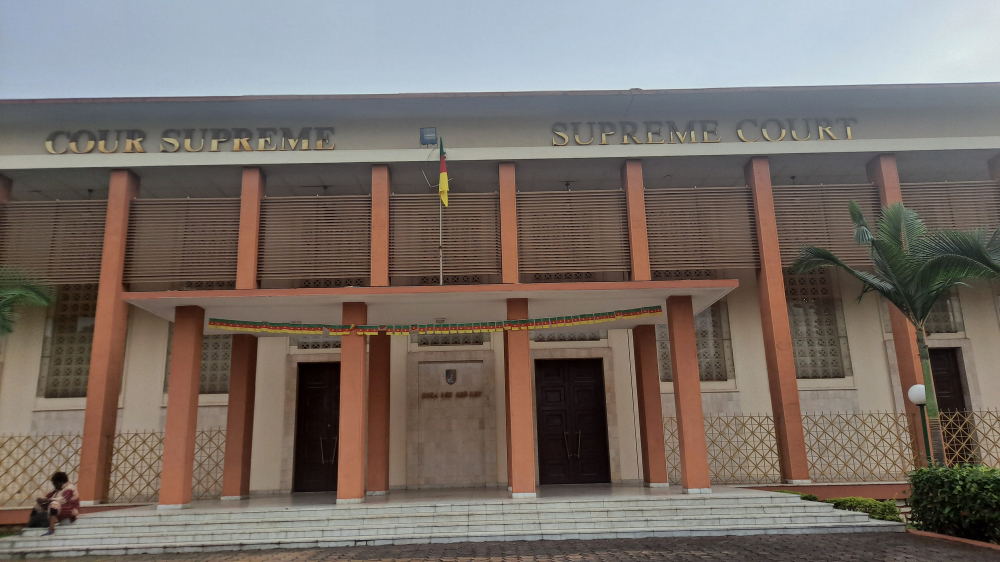
Mrs. Justice Abomo Marie Louise on March 19, 2026 dismissed the September 17, 2020 judgement of the Centre Regional Court of Appeal. Which upheld the life sentences passed against the 10 by the Yaounde Military Tribunal on August 20, 2019.
In a historic and unexpected legal turnaround, the Supreme Court of Cameroon sitting in Yaounde has delivered a seismic ruling in the case involving 10 prominent Anglophone separatist leaders, including Julius Sisiku Ayuk Tabe. On Thursday, March 19, 2026, the nation’s highest court quashed the ruling of the Centre Regional Court of Appeal, which had previously upheld the life sentences imposed on the defendants. The Supreme Court not only annulled the Appeal Court’s decision, but also declared the proceedings leading to it null and void, ordering that the matter be returned to the same court for a completely fresh hearing before a different and legally constituted jury.
Brisk Ruling
The decision, delivered in a brisk judgment lasting less than five minutes by Mrs. Justice Abomo Marie Louise, the President of the jury, represents a significant victory for the defense team. It effectively acknowledges that the judicial process at the Court of Appeal level was fundamentally flawed. The ruling ends a years-long legal limbo for the appellants - often referred to as the “Nera 10” - who were arrested in Nigeria in 2018, extradited to Cameroon, and subsequently convicted on charges including terrorism, secession, and aiding and abetting terrorism.
By sending the case back to the Centre Regional Court of Appeal for a re-hearing, the Supreme Court has highlighted the gravity of the procedural irregularities that have marred this case from its inception. The judgment implies that the rights of the defense were violated and that the previous panel at the Court of Appeal was not properly constituted to hear the matter. This development sends shockwaves through the Cameroon legal landscape, particularly given the highly charged political nature of the Anglophone crisis and the international attention this specific case has garnered.
The Third Hearing
The Supreme Court’s intervention came during the third hearing in the matter, an appeal that was originally filed on March 3, 2020. The Centre Regional Court of Appeal had on September 17, 2020, confirmed the judgment of the Yaounde Military Tribunal from August 20, 2019, which sentenced the 10 separatist leaders to life imprisonment. However, the apex court’s decision to quash these rulings on Thursday validates the long-standing arguments of the defense: that the trial and subsequent appeal were riddled with injustices that made a fair verdict impossible.
A “Huge Victory”
Outside the courtroom, the atmosphere was electric as a team of over 10 defense counsel addressed a gathering of journalists. The consensus among the legal heavyweights was clear: the ruling was a vindication of their efforts and a rare admission of judicial error by the State in a politically sensitive case.
Senior Barrister Akere Muna, a former President of the Cameroon Bar Association and one of the lead counsel for the 10 Anglophone separatist leaders, was the first to speak. He described the ruling as a "huge victory," emphasizing the remarkable nature of the court’s decision.
"The ruling has been given. The ruling of the Court of Appeal of the Centre Region has been quashed by the Supreme Court of Cameroon," Muna stated. "The first thing which is remarkable is that the Supreme Court did not use any of the grounds raised by the counsel for the appellants. Rather, it brought up its own ground. That's the only ground on which it ruled."
Acted “Suo Moto”
Muna explained that the Supreme Court acted suo moto - a legal term meaning the court took the initiative to act on its own volition without any party requesting or prompting them to do so. By raising this ground independently, the court quashed the decision of the Court of Appeal for the Centre Region and sent the parties back to that court according to the law.
"That on its own is a huge victory that our Supreme Court acknowledges that there was injustice in the process," Muna continued. "The take-home message is that the Supreme Court of Cameroon said there was injustice in the manner the Court of Appeal for the Centre Region handled the appeal of our clients against the earlier ruling of the Yaounde Military Tribunal. That to me is a victory."
Appellants Treated With Respect
Muna further noted the demeanor of the court during the proceedings, pointing out that the defendants were treated with a level of respect they had not previously experienced. "Secondly, I think that the proceedings in the Supreme Court were held in such a way that the defendants, the accused persons, felt at ease and comfortable. This to me also is something which is rather important."
Addressing the next steps, Muna indicated that he and his colleagues would carefully analyze how to proceed in the Court of Appeal for the Centre Region. He acknowledged that the road ahead remains complex due to the multitude of pending issues, many of which are procedural in nature.
"I and my colleagues will now sit down and look carefully at how we proceed in the Court of Appeal for the Centre Region because there are many issues pending. In the Court of Appeal, a lot of the problems raised were procedural, the serious procedural defects before the Yaounde Military Tribunal. So it makes the case easy, and at the same time complex," Muna elaborated.
The Potential Legal Paths Ahead
He outlined the two potential paths the new Appeal Court panel might take. It could either accept that the entire process was flawed from the start and overturn the convictions by the Yaounde Military Tribunal. Or it could attempt to hear the case anew - a prospect Muna described as "practically impossible" given the nature of the violations cited.
"The case is easy in the sense that the Court of Appeal can just say they accept everything because everything was wrongly done. Or it can also go ahead and say, well, we'll see how we can hear this case - which is practically impossible in view of the nature of the violations that we're talking about. You know the Yaounde Military Tribunal handled the matter in a haste and news was also influencing the course of proceedings," Muna argued.
Reflecting on the historical significance of the day, Muna added, "I think we are in for an interesting legal ride. What the Supreme Court of Cameroon has done today is unique in our own political and legal history - by acknowledging the fact that there was injustice."
Muna spent considerable time explaining the legal nuance of the suo moto intervention, a point he felt was crucial for the public to understand.
What Is “Suo Moto”?
"But what the public needs to remember is that the decision of the Centre Region Court of Appeal was quashed by the Supreme Court for reasons, for grounds it raised itself – Suo moto (a situation where a court or a judge takes the initiative to act without any party requesting or prompting them to do so). It is difficult to say why the court raised this ground of appeal for its ruling."
He noted that the defense had raised many grounds in previous hearings, and the Supreme Court had previously critiqued the defense for not fully enunciating certain grounds, which were basically matters of form. Muna speculated that it was strategically easier for the Supreme Court to take inspiration from the defense's arguments and raise a ground instead of trying to "tinker around" with the specific grounds raised by the appellants' lawyers.
Courage, Equilibrium
"And also, in terms of equilibrium, I think that there was also some kind of feeling of less majesty if the Supreme Court were to adopt our own grounds of appeal. So the Supreme Court decided to raise grounds on its own and rule on the grounds it raised. That's my opinion about what happened today."
When asked if the ruling could be described as a legal precedent, Muna was cautious but firm in his praise for the court's independence. "A precedent, no, but in such a politically charged matter, the Supreme Court was 'courageous' enough - sorry to use the word - to say there was injustice. And that the Court of Appeal for the Centre Region was not properly constituted when it ruled on our appeal against the judgement of the Yaounde Military Tribunal."
Cautious Optimism
Following Barrister Muna, Barrister Paddy Yong, one of the lead counsel for the Nera 10 appellants, addressed the press. He characterized the judgment as a "milestone" and described the ruling as "very encouraging." Barrister Yong provided insight into the legal options available to the Supreme Court under the law organizing the court. He noted that after observing that the proceedings in the Centre Regional Court of Appeal were replete with irregularities, the Supreme Court had the jurisdiction to bypass the lower court and hear the matter afresh itself.
Pressed on whether they could have heard the matter afresh, Yong confirmed, "Yes, they could have gone ahead to hear the matter all over because that was not done in the Court of Appeal. It was not also done in the trial court, in the Yaounde Military Tribunal." However, the Supreme Court chose the option of remand. "So well, it's an option. They have decided to take the option, send it back to the Court of Appeal for a re-hearing."
What Next?
Yong explained the procedural mechanics of what comes next. The judgment of the Supreme Court will be formally typed, and the proceedings will be physically sent back to the Court of Appeal. Once received, the Court of Appeal will issue new summonses to the defense counsel, providing a new date for the appearance of the appellants.
Despite the victory, Barrister Yong expressed concern over the time factor. The appellants have been in detention for a significant period, and sending the case back for another round of appeals could delay their release further.
"We hope they don't sleep on their laurels because our clients have been in prison for about 9 years already. I'm not blaming the Supreme Court. They had an option in law and they used it. But on my part, I thought having stayed so long in prison, if the Supreme Court took the other option of hearing the matter afresh, it would have done a lot of justice to our clients," Yong admitted.
Implications Of The Ruling
Barrister Fru Joseph, another member of the defense counsel, highlighted the international dimensions of the case. He argued that the Supreme Court’s ruling served to validate the findings of international human rights bodies. "It is cardinally important because it's not only the Supreme Court that has outlined this idea of underlying injustice. The United Nations Working Group on Arbitrary Detentions had already opined on this and said that the detention of the 10 Anglophones was illegal and illegitimate and unconscionable," Fru Joseph stated.
Legal Comparison
He drew a direct line between the UN's findings and the Supreme Court's actions, suggesting that the pressure and observations of international jurisdictions played a role in the domestic outcome. "And so when you have the Supreme Court of Cameroon harping on such injustice, it suggests that international jurisdictions have seen something grossly wrong with the case."
Fru Joseph concluded with a probing question about the hierarchy of judicial remedy in Cameroon. If the Court of Appeal commits errors that the Supreme Court cannot fully resolve but instead must remand, it raises questions about the finality and efficiency of justice in such complex cases.
"Procedurally, if the Court of Appeal did something wrong and the Supreme Court cannot solve it, then who solves it? That's the question. That's the question," Fru Joseph posed to the press.
The Appellants’ Perspective
Perhaps the most poignant reaction came from Julius Sisiku Ayuk Tabe. Speaking on behalf of the nine other co-accused, Ayuk Tabe expressed gratitude for the opportunity to be heard, even as he lamented the fact that the ruling did not go as far as their immediate release.
"We appealed the case and the Supreme Court has said four or five years later that the judgement of the Court of Appeal for the Centre Region is quashed. That in itself is to say that our appeal had good grounds, and the right thing the Supreme Court ought to have done was to release us. Failing to do so, they have sent us back," Ayuk Tabe stated.
He maintained a strict legalistic view of the upcoming process, arguing that the logical conclusion of the Supreme Court's finding is that the case must eventually be remanded all the way back to the Military Tribunal, where the initial violations occurred.
Back To The Drawing Board
"As we go back to the Appeal Court, it has to send us back to the Yaounde Military Tribunal because all 10 of us were never arraigned," Ayuk Tabe insisted. Despite the frustration of continued detention, Ayuk Tabe took a moment to appreciate the conduct of the Supreme Court proceedings, drawing a sharp contrast with their experiences in the lower courts.
"Mrs. Justice Abomo Marie Louise listened to us. She heard us out, and that's something we have not enjoyed since we started in the Yaounde Military Tribunal. Nobody has ever listened to us this way," Ayuk Tabe said.
He recounted the trauma of the trial at the Yaounde Military Tribunal, where he felt the defendants were stripped of their basic rights. "The military court dismissed us, dismissed everything we wanted to say. Our lawyers left the court, and the military court still went ahead to give us life sentences. You don't judge people for felonies without their lawyers."
In The Court Premises
Early in the morning, the stage was already set for the landmark ruling. The 10 Anglophone separatist leaders, who had been sentenced to life imprisonment in 2019 by the Yaounde Military Tribunal, arrived at the Supreme Court with a sense of anticipation that they and their counsel will "live to remember for a long time to come."
At 8:50 a.m., a van from the Kondengui, Yaounde Principal Prison transporting the appellants drove into the Supreme Court premises in Yaounde’s Central Business District. The security measures were intense. The prison van was accompanied by heavily armed prison officers and a pick-up van filled with elite gendarmerie guards, reflecting the high-profile and sensitive nature of the detainees.
As the 10 men stepped out one after another from the white Toyota Hiace mini-bus, the mood shifted slightly from the rigidity of prison transport to a moment of human connection. They were welcomed by waiting defense counsel and a few relatives. Handshakes and hugs were exchanged, a brief respite from their incarceration, before they walked along a long corridor to the ground floor sprawling court hall of the Supreme Court of Cameroon.
The 10 appellants remained outside the hall for a few minutes, sharing pleasantries with members of the crowd - mostly other relatives and acquaintances. This interaction took place under the watchful eyes of prison and gendarme guards who hovered around, ensuring the security protocol was maintained despite the relaxed atmosphere. Eventually, the men took their seats in the court hall as judicial aides continued putting last touches to preparations to ensure the hearing took place in optimal conditions.
As The Hearing Opened
At exactly 9:34 a.m., the bell rang through the length and breadth of the large court hall, announcing the arrival of the panel of trial Justices and the Advocate General. The ringing also marked the official beginning of court hearings, as there were other matters on the roll. The first matter to be called up was the most consequential: The State of Cameroon versus Sisiku Ayuk Tabe Julius and 9 other Anglophone separatist leaders.
In her “roll call,” Mrs. Justice Abomo Marie Louise called the appellants to the dock - or to the front of the court, facing the justices. Without much ado, she proceeded to read the brisk judgment in the appeal filed by the 10 separatist leaders. The group is otherwise referred to as the “Nera 10,” a name derived f...
Cet article complet est réservé aux abonnés
Déjà abonné ? Identifiez-vous >
Accédez en illimité à Cameroon Tribune Digital à partir de 26250 FCFA
Je M'abonne1 minute suffit pour vous abonner à Cameroon Tribune Digital !

- Votre numéro spécial cameroon-tribune en version numérique
- Des encarts
- Des appels d'offres exclusives
- D'avant-première (accès 24h avant la publication)
- Des éditions consultables sur tous supports (smartphone, tablettes, PC)










Commentaires