

The Pontificate Of Leo XIV : A Pastor With A Missionary Heart For The Digital Age
- Par Kimeng Hilton
- 14 Apr 2026 17:15
- 0 Likes
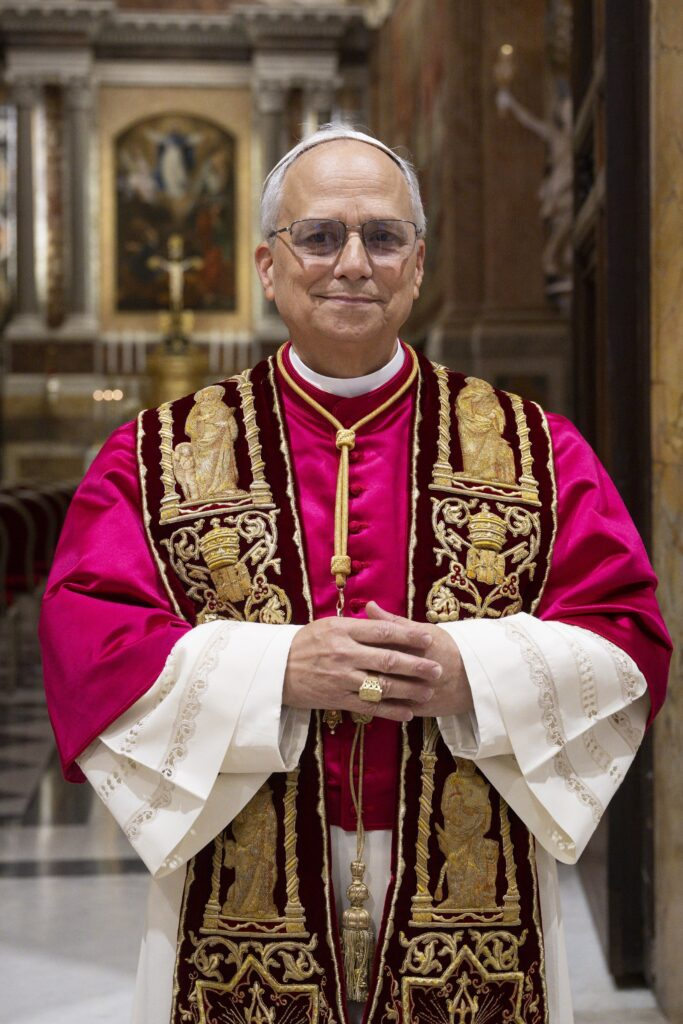
The Worldwide Leader of the Roman Catholic Church arrives in Cameroon on April 15, 2026. For a four-day visit that will also take him to Bamenda and Douala.
The election of His Holiness Pope Leo XIV on May 8, 2025, marked a transformative moment in the 2,000-year history of the Roman Catholic Church. As the 267th Bishop of Rome, the former Cardinal Robert Francis Prevost brought several historic "firsts" to the Chair of Saint Peter. He is the first Pope born in the United States of America, the first from the Augustinian Order in centuries, and the first to hold dual citizenship of the United States and Peru. His rise to the papacy represents a bridge between the institutional power of the Global North and the missionary vitality of the Global South.
Early Life, The Augustinian Call
Born on September 14, 1955, in Chicago, Robert Prevost was raised in a household that balanced American labor values with deep Catholic piety. After graduating from Villanova University with a degree in Mathematics - a background that arguably informs his current precision in addressing complex technological ethics - he felt a persistent calling to the religious life. He joined the Order of Saint Augustine and was ordained in Rome in 1982.
His academic journey led him to earn a Doctorate in Canon Law from the Pontifical University of Saint Thomas Aquinas (Angelicum). However, it was his subsequent move to Peru that forged the "smell of the sheep" that would later define his ministry. Spending over two decades in Northern Peru, particularly in the Diocese of Chiclayo, he became known as a "Bishop of the peripheries," often seen navigating difficult terrain to reach the most isolated communities.
Leadership On The Global Stage
Before his elevation to the papacy, Prevost served two terms as the Prior General of the Augustinian Order in Rome, overseeing the global congregation from 2001 to 2013. His ability to manage a diverse, international body prepared him for his appointment by Pope Francis in 2023 as the Prefect of the Dicastery for Bishops. In this role - often described as one of the most powerful in the Vatican - he was responsible for vetting candidates for the episcopacy worldwide. Ensuring a new generation of leaders who mirrored the "servant-leadership" model of the Second Vatican Council.
The Choice Of "Leo" And The Social Question
The selection of the name Leo XIV was a deliberate and profound signal to the world. It honors the legacy of Pope Leo XIII (1878–1903), the author of Rerum Novarum, the foundational document of modern Catholic Social Teaching. Just as Leo XIII addressed the "new things" of the Industrial Revolution - such as labor rights and the dignity of the worker - Pope Leo XIV has dedicated his first year to the "new things" of the 21st Century: Artificial Intelligence, environmental justice, and global economic disparity.
Pillars Of The Current Pontificate (2025–2026)
As of April 2026, the papacy of Leo XIV is defined by three primary pillars that reflect his missionary roots and his intellectual rigor:
The Ethics of Technology And AI. In several addresses cited by Vatican News, the Pope has argued that while technology is a gift from God, it must never replace human soulfulness. He has become a leading moral voice calling for "Algor-ethics" - a framework to ensure that AI serves the common good and does not further marginalize the poor. He famously stated in a January 2026 address that "a machine can calculate, but only a human can care."
Synodality And A Listening Church. Continuing the work of his predecessor, Pope Francis, ...
Cet article complet est réservé aux abonnés
Déjà abonné ? Identifiez-vous >
Accédez en illimité à Cameroon Tribune Digital à partir de 26250 FCFA
Je M'abonne1 minute suffit pour vous abonner à Cameroon Tribune Digital !

- Votre numéro spécial cameroon-tribune en version numérique
- Des encarts
- Des appels d'offres exclusives
- D'avant-première (accès 24h avant la publication)
- Des éditions consultables sur tous supports (smartphone, tablettes, PC)









Commentaires