

“Respect God, Not Man”: Pope Leo XIV Challenges Power Dynamics In Cameroon’s Conflict
- Par Kimeng Hilton
- 16 Apr 2026 19:02
- 0 Likes
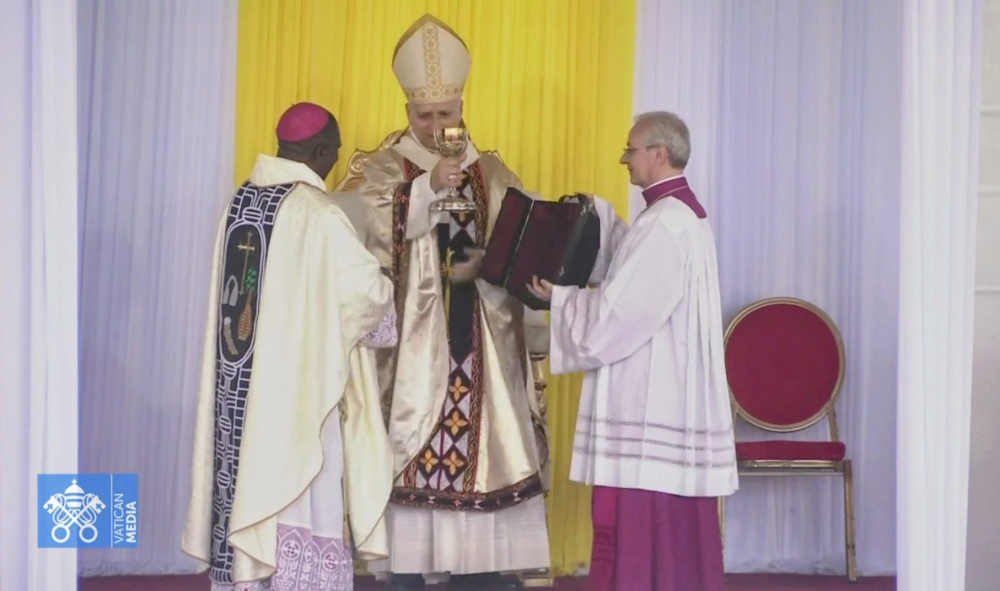
He held a mass at Bamenda-Bafut Airport on Thursday April 16, 2026 before taking off for Yaounde at 5.30pm.
On a day the Grassfields cold seemed to pause to witness history, the Bamenda-Bafut Airport was transformed from the noise of aircraft landing and taking into a sanctuary of defiant hope. This Thursday, April 16, 2026, Pope Leo XIV stood before a sea of more than 30,000 people - many of whom had emerged from the "bush" or traveled through dangerous checkpoints - to deliver a message that struck at the very heart of the Anglophone Crisis.
Liturgical Celebration
The air was thick with the scent of dust and incense as the Chicago-born Pontiff, known for his directness and rejection of diplomatic euphemisms, stepped onto the elevated dais. The Mass was more than a liturgical celebration; it was a spiritual declaration of independence for a people caught between the crossfire of the state and separatist factions.
The Sovereignty Of Conscience
Pope Leo XIV’s homily was centered on a singular, jarring theme: the hierarchy of obedience. In a region where "loyalty" is often demanded at the point of a gun, the Pope’s words acted as a theological sledgehammer.
Respect God, Not Man
“Too often in this beautiful land,” the Pope began, his voice echoing across the tarmac via massive speaker stacks, “You are told that to survive, you must fear the one who can destroy your home or take your life.”
He leaned into the microphone, his gaze sweeping across the rows of displaced families and wounded veterans.
“I say to you today: Respect God and not man. Do not fear those who can kill the body but cannot touch the soul. When a human law commands you to hate your brother, it is no law at all. When a commander orders you to spill innocent blood, your first allegiance is to the Commandment written in stone and spirit: Thou shalt not kill.”
The crowd, usually reserved in the presence of the Papacy, erupted in a roar of "Amen" that seemed to vibrate the very planes parked in the distance. The Pope was not just offering comfort; he was offering a moral framework for resistance against the culture of violence.
The Critique Of “False Masters”
Leo XIV did not mince words regarding the leaders on both sides of the conflict. He criticized the "arrogance of the powerful" who believe they can redraw borders with blood or maintain order through terror. “The masters of this world are fleeting,” he shouted. “They are like the grass that withers in the afternoon sun. But the Word of the Lord stands forever. To follow God is to choose peace even when the world demands war.”
The Liturgy Of The Displaced
The Mass itself was a masterpiece of inculturation. The choirs of Bamenda, accompanied by traditional drums and xylophones, sang hymns that blended Latin chant with the rhythmic soul of the Northwest.
During the offertory, instead of gold or silver, a group of internally displaced persons (IDPs) brought forward symbols of their lost livelihoods: a rusted hoe, a charred schoolbook, and a single branch from a coffee tree. The Pope blessed these items, weeping openly as he touched the remnants of a community’s broken dreams.
“In this bread and wine,” he said during the Consecration, “we place the suffering of every village from Akwaya to Kumbo. This is the body of Christ, broken just as your families have been broken. But it is also the Body that rises.”
Archbishop Nkea’s Vision
As the sun began to dip toward the horizon, casting long shadows over the Bafut plains, Archbishop Andrew Nkea of Bamenda rose to give the concluding address. Nkea, who has spent years walking the tightrope of mediation between the government and the Ambazonian separatists, looked visibly transformed by the day’s events.
His response was one of the most profound prophetic utterances in the history of the Cameroonian Church. He did not speak of political treaties or administrative reforms; he spoke of a cosmic shift in the spiritual atmosphere of the land.
Pope Leo XIV ended Mass at the Bamenda Airport by offering a special gift to the people of Bamenda: a chalice, which he handed to Archbishop Andrew Nkea. A chalice is the sacred cup used during Mass, which holds the wine that becomes the Blood of Jesus Christ during the consecration.
The Long-Lasting Impact
“Holy Father,” Nkea began, turning to the Pope, “The blessing you have brought today is not a passing shadow. It is a fire that has been lit in the heart of the forest.” The Archbishop then moved into a vivid, metaphorical description of the peace he believed would now descend upon the region - a peace so radical that it defied the laws of nature.
Incompatible Becomes Compatible
He said the Pope’s blessing will have a long-lasting impact on the land. ...
Cet article complet est réservé aux abonnés
Déjà abonné ? Identifiez-vous >
Accédez en illimité à Cameroon Tribune Digital à partir de 26250 FCFA
Je M'abonne1 minute suffit pour vous abonner à Cameroon Tribune Digital !

- Votre numéro spécial cameroon-tribune en version numérique
- Des encarts
- Des appels d'offres exclusives
- D'avant-première (accès 24h avant la publication)
- Des éditions consultables sur tous supports (smartphone, tablettes, PC)








Commentaires