
The Final Push: Cameroon Targets 2 Million Children In Far North Polio Blitz
- Par Kimeng Hilton
- 22 Apr 2026 16:56
- 0 Likes
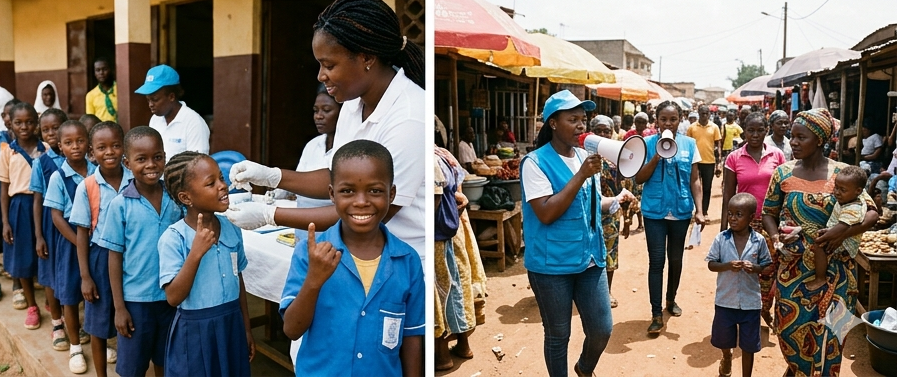
A media debriefing session was organized in the regional capital, Maroua this Wednesday April 22, 2026 – ahead of the immunization from April 23-26, 2026.
In the sweltering heat of Maroua, the capital of Cameroon’s Far North Region, a sense of quiet urgency permeates the minds of health officials and development partners. It is Wednesday April 22, 2026, a date that marks both a milestone and a warning. For 12 months, this region - a landscape of resilience nestled against the borders of Nigeria and Chad - has not recorded a single case of the circulating variant poliovirus type 2 (cVDPV2).
High Stakes
Yet, as health experts, international partners, and media professionals gathered for a high-level "Media Cafe" or media debriefing, the message is clear. Complacency is a luxury the children of Cameroon cannot afford.
The stakes are staggering. Across the border in Nigeria, nine cases of cVDPV2 and one case of cVDPV3 have already been recorded this year. With porous borders and the constant movement of traders, farmers, and displaced families across the Lake Chad Basin, the virus is effectively a plane ride - or a footbridge - away.
The Reality Of The Threat
Dr. Yaya Alhadji Adam, the Coordinator of the Expanded Programme on Immunisation (EPI) for the Far North, did not mince words during the briefing. While the region celebrates a year of being polio-free, he characterized the current situation as a state of preparation for an inevitable challenge.
"Poliomyelitis in the Far North Region is a reality," Dr. Adam stated. "We have a lot of cases in neighbouring countries. Therefore, we are obliged to prepare ourselves. That's why we are organising all these vaccination campaigns so that we can complete the routine vaccination performances."
The April 2026 Campaign
The logistics of the upcoming campaign, scheduled from April 23-26, 2026, are massive. The Local Immunization Days (Round 1) cover six key regions: Adamawa, Center, East, Far North, Littoral, and North. The target population is 6,390,180 children nationwide. The Far North targets 2,020,174 children (nearly one-third of the national goal).
The strategy to be employed is a combination of door-to-door visits, fixed posts in health centers, and mobile teams designed to reach "zero-dose" children in hard-to-reach cross-border areas.
The technical data reveals why the Far North is the "eye of the storm." The region serves as a gateway. Intense cross-border movement for trade and farming means that a virus originating in a village in Nigeria or Chad can appear in a Maroua marketplace within 48 hours.
Holistic Health Approach
While the focus of the week is polio, Dr. Adam reminded the public that the EPI’s mission is broader. The infrastructure used for the polio campaign - the cold chain, the trained vaccinators, the community registers - is also the defense against other "epidemics that threaten us," such as measles and yellow fever.
The Ministry of Public Health is working "tirelessly," according to Dr. Adam, to ensure that no child remains unvaccinated. This involves not just providing the vaccine, but ensuring the logistics of refrigeration are maintained in a region where temperatures often soar, and electricity can be inconsistent.
Synchronized Regional Strategy
The "weapons" in this fight, as Dr. Adam describes them, are not just the vaccines themselves, but the systems of surveillance and the "Local Immunization Days" (LID) that act as a firewall. This April 2026 campaign is not an isolated effort; it is part of a synchronized regional strategy to boost immunity where routine vaccination coverage has stagnated at approximately 70% - well below the 90-95% required for herd immunity.
The Efficacy Of Two Drops
At the heart of the mobilization is the United Nations Children’s Fund, UNICEF, whose Country Representative in Cameroon, Nadine Perrault, underscored that polio eradication is far more than a medical challenge - it is a socio-behavioral crusade.
"To eradicate poliomyelitis, we need as many actors and partners as possible," Perrault told the assembled media. "This is not just a health issue. We need everyone to help."
Prevention Or Permanent Damage?
Perrault’s address focused on the tragic irony of the disease: the ease of prevention versus the permanence of the damage. Polio, an irreversible condition that can lead to lifelong paralysis or death, can be defeated by "two small drops."
"Vaccinating a child is really protecting the future of this child and the future of Cameroon," she said, invoking the campaign's central slogan. "Once a child has polio, it is a child who has reduced mobility. It is a child who, for life, will have a disability, which can be prevented just with two small drops."
The UNICEF representative highlighted a growing hurdle in the region: vaccine resistance. Despite decades of proven safety, misinformation and "vaccine fatigue" occasionally lead parents to turn vaccinators away. It is here, Perrault argued, that the media becomes the most vital ally.
The Media As The New Frontline
The media debriefing was designed to transform journalists from passive observers into active "allies." By providing them with technical data sheets and direct access to health experts, UNICEF and the Ministry of Health aimed to ensure that information reaches the most remote "ferriques" (chieftaincies) in local languages.
"The goal was not only to give them information but also to strengthen their capacity so that they are also able to communicate, to give the right information," Perrault explained. "People listen to the media. Some of them are leaders in their communities. We are really hoping that we can have them to relay the information and also encourage parents and households."
Press Trips, Community Engagement
Following the Media Cafe, a group of national and local journalists will embark on a two-day "Press Trip" (April 23–24, 2026). They will witness the official launch in a Maroua health district and follow vaccinators into the field. These journalists will visit schools, local chieftaincies, and meet with U-Reporters - youth volunteers who use digital tools to track community needs and spread health awareness.
The field visits are intended to humanize the data. Instead of just reporting on "2 million children," the media will tell the stories of mothers like those who travel miles to ensure their toddlers receive the life-saving drops. And the vaccinators who walk for hours in the sun to reach a single isolated household.
The Moral Imperative
As the briefing concluded, the atmosphere was one of somber determination. The "two little drops" have become a symbol of a promise made by ...
Cet article complet est réservé aux abonnés
Déjà abonné ? Identifiez-vous >
Accédez en illimité à Cameroon Tribune Digital à partir de 26250 FCFA
Je M'abonne1 minute suffit pour vous abonner à Cameroon Tribune Digital !

- Votre numéro spécial cameroon-tribune en version numérique
- Des encarts
- Des appels d'offres exclusives
- D'avant-première (accès 24h avant la publication)
- Des éditions consultables sur tous supports (smartphone, tablettes, PC)








Commentaires