

Wambo Fabian Yufenyuy: The Man Who Restores Dignity To Departed, Loved Ones
- Par Kimeng Hilton
- 01 May 2026 14:32
- 0 Likes
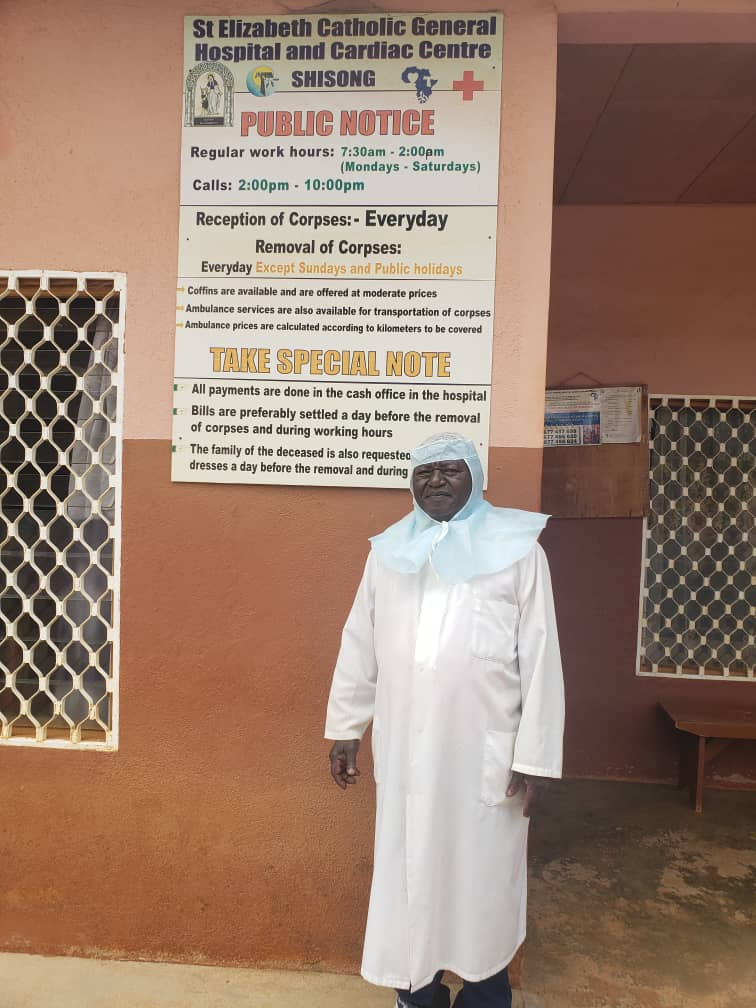
This May 1, 2026 and at 62, the mortuary attendant of Saint Elizabeth Catholic General Hospital and Cardiac Centre, Kumbo, has taken a day off from 26 years of work. To fete Labour Day.
This May 1, 2026, the air in Kumbo in Bui Division of Cameroon’s North West Region is thick with more than just the usual mountain mist. It is heavy with the weight of a decade of conflict, yet lightened by the quiet resilience of a community that refuses to break. At 62, Wambo Fabian Yufenyuy, the lead mortuary attendant of Saint Elizabeth Catholic General Hospital and Cardiac Centre, Shisong, Kumbo, has done something radical: he has taken a day off.
Rhythm Of Arrivals And Departures
For 26 years, Fabian’s life has been measured not by the ticking of a clock, but by the rhythm of arrivals and departures. On this Labour Day, a holiday meant to celebrate the sweat of the brow and the dignity of the worker, Fabian sits in his home in Shisong village. He is a man who has spent a quarter-century in the borderlands between the living and the dead, and today, he chooses the silence of the living.
At 6:45 am, when the first light begins to pierce the rolling hills of the Bui Division, Fabian is usually already at his post. For most people, the dawn represents a fresh start, a new day of life and possibility. For Fabian, it is a return to "his people" - those whose journeys have come to a permanent, often tragic, halt. His workplace is a place of cold tiles and stainless steel, yet he has managed to infuse it with a warmth that defies the physical chill of the refrigeration units.
Still Going Strong
Fabian is 62 years old, an age when many in Cameroon are content to retire to their ancestral lands, sit by a hearth, and recount tales of the past to their grandchildren. But at the Cardiac Centre in Shisong - a facility renowned across Central Africa for its life-saving surgeries - Fabian is considered an indispensable pillar. He is the bookend to the hospital’s mission. While the surgeons work tirelessly to keep hearts beating, Fabian ensures that when those hearts finally fail, the humanity of the person remains intact.
Escort For Hundreds Of Souls
Having served as a mortuary attendant for 26 years, he has become the final escort for hundreds of souls. "It’s my nature," he says with a characteristic shrug when asked about his legendary boldness. In a profession often shrouded in deep-seated African superstition and whispered fears of the "walking dead" or vengeful spirits, Fabian moves with the calm of a man who has reconciled with mortality. He often tells his trainees that the dead cannot hurt you; it is the living, with their capacity for malice and corruption, that one must watch.
Accidental Vocation
Fabian’s path to the mortuary was not paved with a childhood dream of funeral service. There was no family lineage of undertakers. In the late 1990s, Fabian was a simple gardener at Shisong Hospital. He spent his days tending to the hibiscus and the manicured lawns that provided a serene, green backdrop for the sick and recovering. He dealt in growth, in the scent of damp earth and the bright colors of the tropics.
When the hospital administration decided to establish a formal, modern mortuary in 1999, they didn't look for outside recruits with specialized diplomas. They looked at their own staff - at the men who showed up on time, who worked with their hands, and who possessed a certain emotional sturdiness. Fabian was chosen.
He Accepted!
"They asked my opinion and I accepted," he recalls, his voice steady. "When you work in an institution and you are sent to a department, if you are able to do it, you do. If you are not, then you inform your boss."
This pragmatic philosophy - rooted in a deep sense of institutional loyalty and the Catholic work ethic - transformed the gardener into a mortician. He didn't see the move as a demotion to a "darker" place. Instead, he approached the preservation of human bodies with the same meticulous care he had used to prune roses. Where others saw omens and ghosts, Fabian saw a task that needed to be done with dignity. He swapped the trowel for the trocar, and in doing so, found his true calling.
The "Shisong Standard"
To the uninitiated, mortuary work is often viewed as grim and mechanical - a series of chemical injections and logistical hurdles. To Fabian, it is a craft, a final act of artistic and spiritual service. Over the decades, he has developed what locals call the "Shisong Standard," a level of care that has made him a harsh critic of the broader industry.
Fabian speaks with visible disdain for the way corpses are handled in the metropolitan hubs of Yaounde and Douala. In those sprawling cities, the "funeral business" is often exactly that: a business. Bodies arrive from the big cities to the Shisong mortuary for "keeping" before their final burial in the ancestral villages of the North West. Fabian describes these arrivals as "ugly," "twisted," and "in disorder."
Lacking In Many Aspects
"They know how to prepare corpses in the big cities, but they don't know how to finish the job," Fabian remarks. "The hands are twisted, the head… everything, the mouth open… funny things."
In Shisong, Fabian prides himself on the "finish." For him, a person should look like they are in a state of repose, not like a discarded object.
He spends hours ensuring the jaw is set correctly, the limbs are straightened with care, and the expression is one of peace. This commitment to the aesthetic and spiritual dignity of the deceased has turned the Shisong mortuary into a destination. Families from Donga-Mantung and Ngoketunjia Divisions bypass closer other facilities to bring their loved ones to Fabian, trusting only him to "set things right."
The Economics Of Grief
In Cameroon, like in many parts of the world, the death of a loved one is not just an emotional blow; it is a financial catastrophe. Funeral costs can skyrocket, and mortuary "tips" are often a mandatory shadow tax. In the major cities, families tell horror stories of being forced to pay for long lists of “required items and services” and "motivation" fees to attendants just to ensure their relative is actually placed in a refrigerated unit.
Fabian’s operation at Shisong stands as a staggering, almost impossible anomaly. The mortuary operates under a code of transparency that feels like a relic from a more honest era. "The system has instructed us not to ask for money," Fabian explains. The cost is a flat 5,000 FCFA per day. There are no hidden fees. No "share" for the attendant. No holding the body hostage for extra payment.
No Coercion!
While Fabian admits that "good people offer us motivations" out of genuine gratitude for his care, there is no coercion. In a rural setting where families often struggle to afford even the most basic wooden casket, this affordability is a lifeline.
It is a service fueled more by the Catholic mission of the hospital - the Tertiary Sisters of Saint Francis - than by the profit margins of the funeral industry. Fabian sees himself as an extension of the church's charity, a man ensuring that poverty does not strip a human being of their final dignity.
Life And Death In A War Zone
The backdrop to Fabian’s career is the "Anglophone Crisis" - the protracted conflict between separatist forces and the State military that has rocked the North West and South West Regions of Cameroon since 2016. The war has turned the rolling hills of Bui into a landscape of checkpoints, "ghost towns," and sporadic violence.
The war has touched every aspect of life in Shisong. Between 2019 and 2020, the hospital’s operations were so severely hampered by the fighting and the displacement of staff that Fabian spent 10 months at home without a salary. During those months, the "silence" he usually managed in the mortuary spread to the streets.
The Civilian Sanctuary
Yet, death remains a constant, and perhaps more so in a war zone. Interestingly, the Shisong mortuary has remained a civilian sanctuary. Fabian notes that they rarely receive the bodies of State and Non-State Combatants - either "Amba" fighters or military personnel. Those bodies are usually handled through different channels. Instead, Fabian deals with the civilian toll: the elderly who died because they couldn't get medicine during a lockdown, or those caught in the crossfire of a conflict they never asked for.
Precarious Environment
The war has made his work more precarious. Travelling to work during a "ghost town" (a forced strike) or during active gunfire is a risk he has taken countless times. On this Labour Day, May 1, 2026, the scars of the conflict are visible in his refusal to celebrate.
"How do you expect us to celebrate when we are in a war zone?" he asks. For Fabian, the holiday is not for parades or speeches by trade union leaders who stay far from the frontlines. It is simply a day of much-needed rest, a brief pause in a lifetime of labor that has become increasingly heavy.
Passing On The Torch
Fabian officially retired last year. He had reached the age, he had put in the time, and his body was beginning to feel the decades of heavy lifting. But his exit was short-lived. The hospital administration soon realized that Fabian was not just an employee; he was the institutional memory of the mortuary. The "stable person" needed to run such a sensitive department simply wasn't there.
Difficult To Manage, But Possible
Death is a difficult business to manage, not just physically, but emotionally and administratively. The hospital pleaded for him to return on a contract basis to train two younger men. Today, Fabian is a mentor. He is passing on the "Shisong Standard" to a new generation who must learn to operate in an increasingly complex world.
He teaches them the technical skills: the correct mix of preservation fluids, the logistics of the cold chain, and the administrative rigor required. But more importantly, he teaches them how to maintain their humanity. He warns them against the "hardening of the heart" that often comes with the job. He shows them that a body is not a "case number," but someone’s father, sister, or child.
The Heart Of The Mortician
Perhaps the most poignant moment of Fabian’s reflection is his insistence that 26 years of cold skin and silence have not turned him into a machine. There is a common misconception that morticians are morbid, cold-hearted individuals who enjoy the company of the dead more than the living. Fabian shatters this stereotype with a single question.
"Do you know that if my [own kin] dies, I cry?" he asks. "I am no different from other people, I have the same human feelings."
He views his work not as a morbid fascination, but as a form of ministry. "We are serving Christ through people," he says, echoing the Catholic ethos that defines the Shisong Cardiac Centre. To Fabian, the Corporal Works of Mercy - one of which is to bury the dead - is a daily reality. He is the person who performs the work that others are too afraid, too disgusted, or too heartbroken to do.
A Neighbor, Not A Ghost
As the sun begins to set over Kumbo, Fabian often walks the 15 minutes from the hospital back to his home in Shisong village. In many cultures, a man who spends his days touching the dead would be an outcast, a figure of bad luck to be avoided. But as Fabian walks, he is greeted by name by almost everyone he passes.
"Pa Fabian!" the children call out. The market women nod in respect. They don't cross the street to avoid him. They don't fear his touch. In Bui Division, Fabian isn't the "Death Man" or a harbinger of doom. He is the neighbor who ensures that when their loved ones finally close their eyes, they do so with the peace and beauty they deserve. He has demystified the most terrifying aspect of human existence by treating it with the normalcy and respect of a daily chore.
The Dignity ...
Cet article complet est réservé aux abonnés
Déjà abonné ? Identifiez-vous >
Accédez en illimité à Cameroon Tribune Digital à partir de 26250 FCFA
Je M'abonne1 minute suffit pour vous abonner à Cameroon Tribune Digital !

- Votre numéro spécial cameroon-tribune en version numérique
- Des encarts
- Des appels d'offres exclusives
- D'avant-première (accès 24h avant la publication)
- Des éditions consultables sur tous supports (smartphone, tablettes, PC)






Commentaires