
Climate Change: Embedding The Dynamics Into National Migration Policy
- Par Kimeng Hilton
- 19 Aug 2026 11:19
- 0 Likes
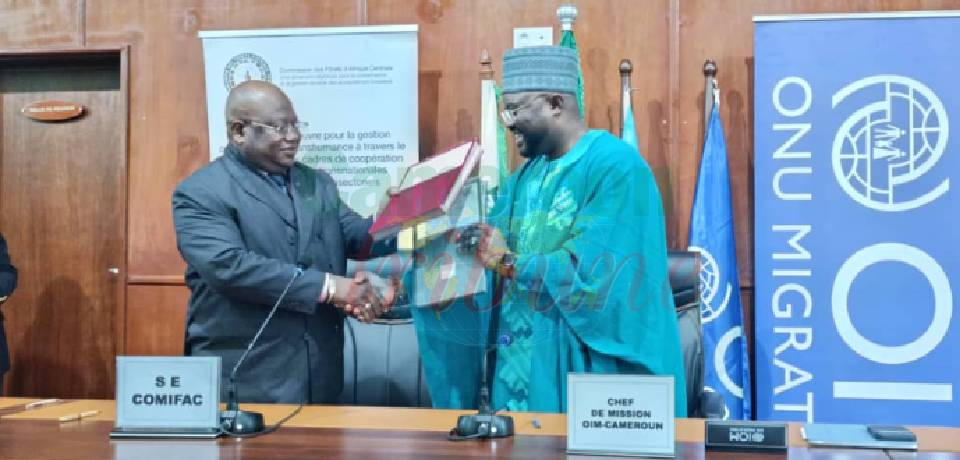
The International Organization for Migration, IOM and the Central African Forest Commission, COMIFAC on August 14, 2026 in Yaounde penned a Memorandum of Understanding.
In a major step toward addressing one of the most pressing socio-environmental challenges facing Central Africa, high-level policy makers, environmental experts, UN officials, and civil society leaders gathered in the Central African Forest Commission, COMIFAC, Yaounde. The national consultation focused on a critical objective. Systematically integrating environmental degradation and climate change considerations into drafting Cameroon’s upcoming National Migration Policy, NMP.
Data-driven Framework
Supported financially by the European Union, EU, the event was jointly organized by the International Organization for Migration, IOM, the Central African Forest Commission, COMIFAC. And Cameroon’s National Observatory on Climate Change, ONACC. The gathering served a dual purpose. To establish a coherent, data-driven framework for national migration governance. And to sign a landmark Memorandum of Understanding, MoU between IOM and COMIFAC to protect forest ecosystems and displaced populations across the region.
Mounting Climate Crisis
Across Cameroon, human mobility patterns are increasingly dictated by environmental pressures and changing weather extremes. The country’s diverse geography - spanning Sahelian northern plains, dense equatorial rainforests, and an extensive Atlantic coastline - makes it acutely vulnerable to the multifaceted shocks of global warming.
In Past Decades
Over the past four decades, northern Cameroon has experienced rainfall declines of up to 25%. Prolonged droughts have degraded arable lands, disrupted traditional transhumance routes for pastoralists, and severely heightened competition over dwindling water and grazing resources.
Coastal communities are battling severe shoreline retreat, with erosion consuming between 1 and 3 metres of beach and land per year. Rising sea levels threaten coastal infrastructure, displace riverine and fishing populations, and compromise local livelihoods. Without structured policy intervention, these slow-onset environmental stressors threaten to accelerate forced displacement, exacerbate rural-to-urban migration, and deepen vulnerability across affected populations.
Historic Regional Alliance
A pivotal moment of the day was the signing of the Memorandum of Understanding, MoU between IOM and COMIFAC. Speaking during the signing, M. Hervé Martial Maidou, Executive Secretary of COMIFAC, outlined why this partnership represents a major structural shift for forest governance in Central Africa.
"The fact that we signed this MoU with the International Organization for Migration is part of the implementation of COMIFAC’s Convergence Plan," declared Mr. Maidou. "COMIFAC is currently reviewing the provisions of its Convergence Plan to integrate aspects related to community displacement. Often, there is a negative impact on the management and governance of forest resources and biodiversity. Therefore, we need to build a solid institutional and legal foundation to support communities," Maidou explained.
Mr. Maidou added that the MoU sets the stage for a long-term partnership aimed at safeguarding community rights. While simultaneously reinforcing environmental protection, forest conservation, and climate adaptation strategies.
Framing Climate Mobility
In his keynote remarks, M. Abdel Rahmane Diop, Chief of Mission for IOM Cameroon, underscored that human migration cannot be analyzed or managed in isolation from the natural environments where it occurs.
"Migration takes place in an environment. Migration takes place in a landscape, and one of the most important landscapes in Central Africa is the forest," Mr. Diop stated. "We cannot pretend to manage migration without giving full interest to some of these ecosystem areas where people are living and moving," Abdel Rahmane Diop noted.
Complex Dynamics
Mr. Diop drew attention to the complex dynamics in Central Africa. Where security conflicts and environmental degradation intersect, forcing displaced populations to seek refuge within forest ecosystems. He laid out three core imperatives for the partnership: Building robust mechanisms to collect accurate data and information regarding climate-induced human movements.
Properly managing human mobility to prevent negative ecological impacts on forest ecosystems. And transforming forest landscapes into sustainable, income-generating hubs for youth and women. So they can thrive within their home communities rather than being forced to migrate out of necessity.
Quoting the World Bank’s Groundswell report, Mr. Diop reminded delegates that climate change could drive up to 216 million internal climate migrants globally by 2050. Including 86 million in Sub-Saharan Africa alone - unless early, coordinated action is taken.
Breaking Down Silos
Cet article complet est réservé aux abonnés
Déjà abonné ? Identifiez-vous >
Accédez en illimité à Cameroon Tribune Digital à partir de 26250 FCFA
Je M'abonne1 minute suffit pour vous abonner à Cameroon Tribune Digital !

- Votre numéro spécial cameroon-tribune en version numérique
- Des encarts
- Des appels d'offres exclusives
- D'avant-première (accès 24h avant la publication)
- Des éditions consultables sur tous supports (smartphone, tablettes, PC)






Commentaires