

Recurrent Douala Floods: Young Architects Outline 4-Point Salvage Strategy
- Par Kimeng Hilton
- 25 Sep 2026 13:53
- 0 Likes
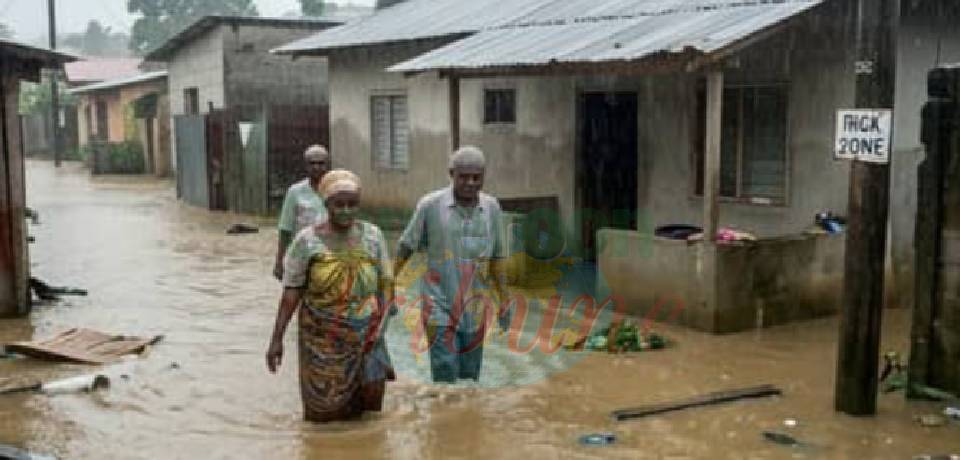
In their conference of September 19, 2026 in Yaounde, the Foumban Architecture School Alumni proposed an overhaul of the city’s land-use controls.
In the wake of destructive seasonal flooding across Cameroon's economic capital, Douala, the Architecture Alumni of the Institute of Fine Arts, Foumban (University of Dschang), operating under the banner of the Amicale des Architectes Made in Foumban (AAMF), convened in Yaoundé on Saturday, September 19, 2026. For what was dubbed “AAMF LIVE TALK 24.”
Stewards Of Urban Safety
Centered on the theme, “Architecture, Floods, and Responsibility: Rethinking Douala,” the professional sensitization conference confronted a critical question. Should architects merely act as technical facilitators for individual building projects? Or step forward as active stewards of urban safety, environmental planning, and flood prevention?
Not Unavoidable Acts Of Nature
Moderated by architectural intern Nkeng Benjamin Yan, with active participation from fellow interns Tagne Henri, Lebogo Alexandre, and Mecu Simba Moïse, the talk assembled an expert panel. Comprising architect-urban planner, Kenfak Joël, architect Guy Gérard Etoa Ngoula, and architectural interns Nzemy Etongo Franklin Serge and Simba Moïse.
The consensus from the session was clear: Douala's recurring floods cannot be dismissed as unavoidable acts of nature. Or minor gutter overflows. Instead, they are the direct product of a structural failure at the intersection of geography, rapid demographic growth, failing infrastructure, and lax urban governance.
Post-Flood Humanitarian RecoveryA major highlight of AAMF LIVE TALK 24 was the contribution of architectural intern Simba Moïse. Who challenged the traditional scope of urban risk assessment. Pointing out that public attention typically evaporates once water recedes, Simba argued that post-flood recovery must be integrated into initial urban planning strategies.
The crisis does not end when the water goes down. The panel raised urgent questions regarding temporary housing. Contaminated borehole water, sanitation hazards, loss of livelihood, disrupted schooling, and disease outbreaks. Like cholera, all of which demand structured post-disaster planning.
Roadmap For Resilient Architecture
To shift Douala from reactive disaster response to long-term resilience, the panelists outlined actionable solutions across four primary axes. In urban planning, Kenfak Joël advocated for strict enforcement of the Urban Development Master Plan, rigorous building permit controls, prohibition of construction in high-risk zones. And shifting urban design to a watershed-wide planning model.
Ecological Corridors
For environmental care, Guy Gérard Etoa Ngoula highlighted the protection and reforestation of coastal mangroves, creation of ecological corridors, reduction of excessive asphalt, and concrete surfaces. And community-led waste sorting to preserve drainage pathways.
Addressing infrastructure, Nzemy Etongo Franklin Serge detailed the systematic clearing and expansion of drainage channels, construction of regional stormwater retention basins. Separation of sewage and rainwater systems, and sustained funding for sanitation maintenance.
Emergency Reception Zones
Finally, regarding humanitarian action, Simba Moïse emphasized establishing pre-planned emergency reception zones, drinking water distribution networks. And designated health response units ready for immediate deployment post-disaster.
Architect's Civic RoleClosing the event, the AAMF reiterated that architects can no longer operate merely as designers of individual building frames. Instead, spatial designers must act as proactive guardians of public safety and environmental integrity. Pushing local authorities and private clients toward climate-resilient construction. Cities must be designed not only to withstand flooding, but to protect human life, organize swift relief, and rebuild better when disaster strikes, the architects argued.
Multidimensional Urban CrisisThe structural factors behind the crisis operate at three interconnected levels. At the natural level, Douala suffers from low topography, high groundwater tables, and heavy coastal rainfall. Anthropogenically, rapid and uncontrolled urbanization has led to severe soil sealing and the destruction of natural wetlands that once absorbed excess water.
Cet article complet est réservé aux abonnés
Déjà abonné ? Identifiez-vous >
Accédez en illimité à Cameroon Tribune Digital à partir de 26250 FCFA
Je M'abonne1 minute suffit pour vous abonner à Cameroon Tribune Digital !

- Votre numéro spécial cameroon-tribune en version numérique
- Des encarts
- Des appels d'offres exclusives
- D'avant-première (accès 24h avant la publication)
- Des éditions consultables sur tous supports (smartphone, tablettes, PC)


Reactions
De la meme catégorie


En kiosque




Commentaires