

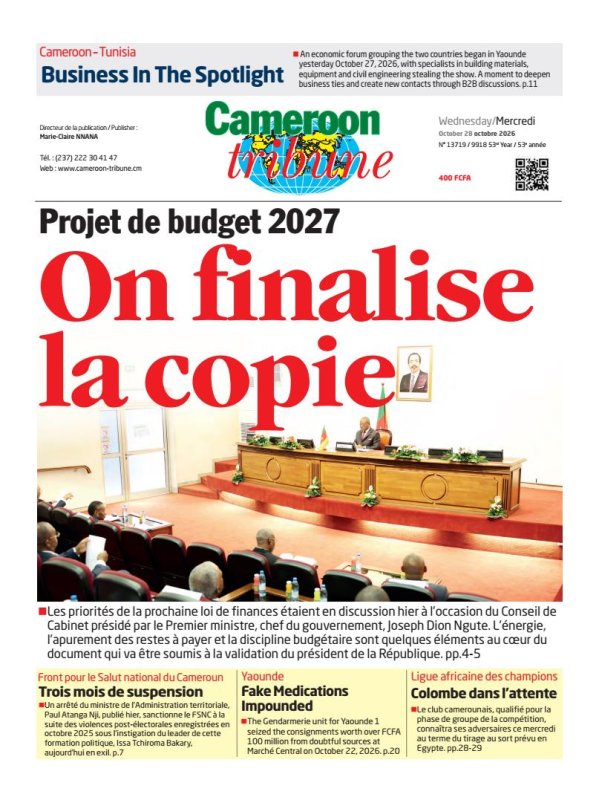
Below is a press release following the cabinet meeting of Tuesday 27 October 2026.
“The Prime Minister, Head of Government, His Excellency Joseph Dion Ngute, chaired a Cabinet Meeting at the Auditorium of the Prime Minis ter's Office on Tuesday, 27 October 2026, at 10:00 am. The meeting was attended by Mi nisters of State, Ministers, Ministers Delegate and Secretaries of State. The following items featured on the agenda: 1. Statement by the Minister of Finance on "Budgetary assumptions and projections for the 2027 financial year; 2. Statement by the Minister of Economy, Plan ning and Regional Development on "The main priorities of the Public Investment Budget for the 2027 financial year"; 3. Miscellaneous. Following the opening statement by the Head of Government, the Minister of Finance outlined the main provisions of the preliminary Finance Bill for the 2027 financial year. The draft was prepared in accordance with the guidelines laid down by the President of the Republic in his Circular No. 001 of 12 October 2026 on the preparation of the State budget. With regard to the international economic en vironment, the Minister of Finance noted that the Finance Bill was being prepared against a global backdrop of persistent geopolitical ten sions, supply chain disruptions, volatile com modity prices and tighter financing conditions. In this context, global economic growth is pro jected at 3.1 % in 2026, rising to 3.4 % in 2027. At the national level, the economic outlook remains subject to uncertainties arising from the external environment, climatic risks, per sistent constraints in the energy sector, and declining oil and gas production. Nevertheless, the resilience of the non-oil sector is expected to sustain economic growth, which is projected to reach 3.6 % in 2027, up from 3.5 % in 2026. Meanwhile, inflation is expected to continue to ease, falling to 3.1% in 2026 and 3.0 % in 2027. With regard to the overall thrust of fiscal policy, the Minister of Finance stated that the 2027 financial year would focus primarily on consolidating public finance, containing public debt and creating fiscal space to support public investment further and accelerate the imple mentation of the 2020-2030 National Deve lopment Strategy (NDS30). Therefore, the Go vernment intends to step up efforts to mobilise non-oil domestic revenue, whilst continuing to rationalise public expenditure. Against this backdrop, the Government's action will focus primarily on consolidating sustained and inclusive economic growth, particularly through the modernisation of the productive sector, enhancing the competitiveness of the national economy and sustainably improving the living conditions of the people. Particular attention will therefore be paid to maintaining security surveillance, strengthening social inclusion and improving mechanisms for identifying and targeting the most vulnerable groups, notably through the implementation of the Unified Social Register and the esta blishment of the National Solidarity Fund. The continued implementation of the Special Fund for the Promotion of Women's Economic Em powerment and Youth Employment will also remain a government priority. In terms of governance, efforts will focus in particular on continuing to clear the State's do mestic debt, pursuing public financial manage ment reforms and accelerating decentralisation by strengthening the financial autonomy of Re gional and Local Authorities, in accordance with the provisions of the law on local taxation. Turning to the revenue and expenditure pro jections for the 2027 financial year, the Minister of Finance stated that budgetary resources would be mobilised primarily through tax and customs revenue, oil and gas revenue, and non-tax revenue. To meet its financing requi rements, the Government also intends to rely, among other sources, on project loans, bank financing and the issuance of government se curities. The main innovations proposed in the prelimi nary Finance Bill relate, in particular, to improving the traceability of economic transactions, ac celerating the digitalisation and demateriali sation of tax and non-tax procedures, and op timising revenue collection mechanisms for the export of certain products. In concluding his presentation, the Minister of Finance highlighted the structural and cyclical constraints that continue to weigh on public finance and stressed the need for greater dis cipline, rigour and efficiency in budget mana gement. Taking the floor in turn, the Minister of Economy, Planning and Regional Development stated that the preparation of the State budget for the 2027 financial year was part of efforts to accelerate the structural transformation of the national economy, in line with the objectives of the 202-2030 National Development Stra tegy (NDS30), with a view to producing a budget more firmly focused on socio-economic impact. In this regard. he noted that, while the economic outlook reflects the resilience of the Came roonian economy, it also underscores the need for greater efforts to accelerate economic...
Cet article complet est réservé aux abonnés
Déjà abonné ? Identifiez-vous >
Accédez en illimité à Cameroon Tribune Digital à partir de 26250 FCFA
Je M'abonne1 minute suffit pour vous abonner à Cameroon Tribune Digital !

- Votre numéro spécial cameroon-tribune en version numérique
- Des encarts
- Des appels d'offres exclusives
- D'avant-première (accès 24h avant la publication)
- Des éditions consultables sur tous supports (smartphone, tablettes, PC)


Reactions
De la meme catégorie

Suspension d’un parti politique
- 28 Oct 2026 11:19
- 0 likes
Front pour le Salut national du Cameroun: Trois mois de suspension
- 28 Oct 2026 11:17
- 0 likes




Commentaires