

Call For Self-Regulation: Government Urges Media Peers To Police Their Own Ethics
- Par Kimeng Hilton
- 03 May 2026 23:39
- 0 Likes
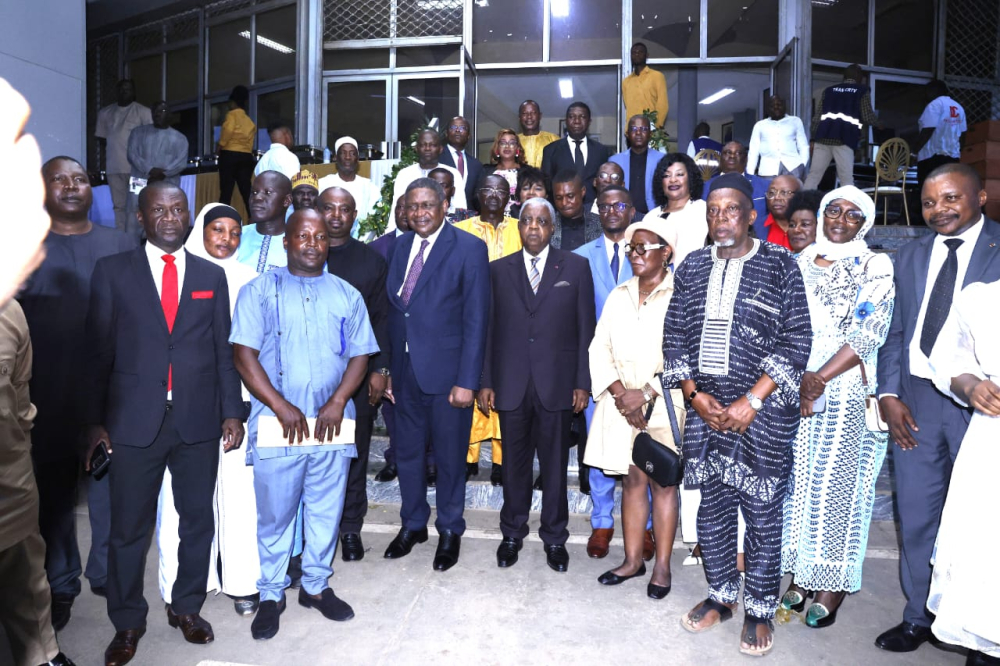
René Emmanuel Sadi, the Minister of Communication and Government Spokesperson, spoke in Yaounde on May 3, 2026 at a press dinner to mark the 33rd World Press Freedom Day.
Cameroon joined the international community on May 3, 2026 to observe the 33rd World Press Freedom Day. The event, held in the capital, Yaounde, served as a vibrant, yet sobering forum for government officials, media practitioners, and international observers to debate the future of information in an era defined by the theme: “Shaping a Future at Peace.”
While the government celebrated decades of media liberalization, the voices of working journalists and international bodies like UNESCO painted a picture of a profession under siege. Not only by legal and physical threats, but by systemic economic hardship and the rising tide of digital disinformation.
Freedom With Accountability
The event was anchored by a comprehensive address from René Emmanuel Sadi, Minister of Communication and Government Spokesperson. Speaking to a packed hall of journalists, the Minister positioned Cameroon as a nation that has stayed the course of democracy since the landmark liberalization laws of 1990.
“Freedom of the press in Cameroon is an undeniable reality,” Minister Sadi declared, tracing the lineage of the country's media landscape back to Law No. 90/052 of December 19, 1990. He credited President Paul Biya - whom he described as a "champion" of press freedom - for fostering an environment where 770 media outlets now operate.
No vacuum For Freedom
However, the Minister’s speech carried a stern warning: freedom cannot exist in a vacuum of accountability. In a world increasingly fractured by armed conflict, Sadi argued that the media must act as a stabilizer rather than a disruptor. He condemned the rise of "hate speech," "irredentist rhetoric," and "seditious content" that threaten the social fabric of the Republic.
Digital Threat, AI
A significant portion of the Minister’s address focused on the "malicious use of Artificial Intelligence, AI" and the spread of disinformation on social media. He noted that while technological advancement has enriched the scope of freedom, it has also opened the door to "fake news" and "identity-based withdrawal."
“These social media platforms... do not operate in a legal vacuum,” Sadi warned, signaling that the government intends to hold digital actors to the same ethical standards as traditional journalists. To combat this, the government is currently finalizing a review of the legal framework governing social communication, aiming to better protect journalists from external threats while simultaneously curbing the "abuses" of the digital age.
The Story Of "Peace"
The atmosphere shifted from policy to the personal when Jude Viban, President of the Cameroon Association of English-speaking Journalists (CAMASEJ), took the podium. In a poignant departure from administrative rhetoric, Viban shared the story of a young female journalist pseudonymously named "Peace."
Gory Tales Of A Journalist
The story of "Peace" was a harrowing microcosm of the industry’s internal rot. Despite her talent and dedication, "Peace" found herself unable to secure a stable living. Her journey was blocked by a gauntlet of systemic failures:
Discrimination and nepotism: Job opportunities dictated by other affiliations rather than merit.
Sexual harassment: A pervasive "dark secret" within newsrooms that forces talented women out of the profession.
The "Gombo" Culture: The economic desperation that leads to a culture of kickbacks, where journalists are paid by sources to cover (or suppress) stories, destroying editorial independence.
“The story of ‘Peace’ is representative of what most journalists in Cameroon go through today,” Viban concluded. His testimony underscored a hard truth: a journalist who cannot afford to eat cannot effectively serve as a watchdog for democracy.
Impunity, Self-censorship
The international perspective was provided by Serge Banyimbe, the representative of the United Nations Educational, Scientific and Cultural Organization, UNESCO Director for Central Africa. His data-driven intervention served as a wake-up call regarding the safety of media practitioners worldwide.
Banyimbe revealed a chilling statistic: between 2022 and 2025, press freedom saw a "drastic reduction" globally. More alarmingly, he noted that 85% of crimes against journalists remain unpunished. This climate of impunity has birthed a secondary crisis: a massive surge in self-censorship.
In Conflict Zones
“The press is an observer of the rule of law and one of its pillars,” Banyimbe stated. He highlighted the "great risks" faced by those reporting from Cameroon’s conflict-stricken regions - the North West, South West, and Far North. He reminded the State that these journalists are not combatants, but are protected under International Humanitarian Law.
In a move toward concrete reform, Banyimbe pledged UNESCO’s support for a government Access to Information draft bill. This legislation would theoretically allow journalists to bypass bureaucratic stonewalling, providing them with the legal right to public data - a crucial tool for investigative journalism and transparency.
Economic Crisis, The Path Forward
One point of consensus between the government and the media corps was the issue of economic viability. Minister Sadi acknowledged that privately-owned media are struggling to survive. He promised that the Ministry of Communication would advocate for a "substantial increase" in State support and institutional aid to help these outlets upgrade their equipment and pay fair wages.
However, the Minister placed the ultimate responsibility for "revival" on the journalists themselves. He called for professional self-regulation - a system where journalists hold their peers accountable through ethics committees - rather than relying solely on State intervention.
A Future Under Construction
As the 33rd World Press Freedom Day concluded in Yaounde, the "Future at Peace" remains work in progress. Cameroon presents a unique paradox: it possesses one of the most diverse and "noisy" media landscapes in Central Africa. Yet it remains a place where journalists are caught between the hammer of State security concerns and the anvil of economic hardship.
The 2026 commemorations made one thing clear: if the media is to help "shape a future at peace," the stakeholders must first find peace within the industry. This requires a transition from a "press of survival" to a "press of professional integrity," supported by a State that views the critic not as an enemy, but as a necessary partner in the democratic project.
Donated Radio Equipment
As the sun set over Yaoun...
Cet article complet est réservé aux abonnés
Déjà abonné ? Identifiez-vous >
Accédez en illimité à Cameroon Tribune Digital à partir de 26250 FCFA
Je M'abonne1 minute suffit pour vous abonner à Cameroon Tribune Digital !

- Votre numéro spécial cameroon-tribune en version numérique
- Des encarts
- Des appels d'offres exclusives
- D'avant-première (accès 24h avant la publication)
- Des éditions consultables sur tous supports (smartphone, tablettes, PC)






Commentaires