

From Douala To Kribi: Cameroon Scales Up Port Capacities For Regional Growth
- Par Kimeng Hilton
- 18 May 2026 14:47
- 0 Likes
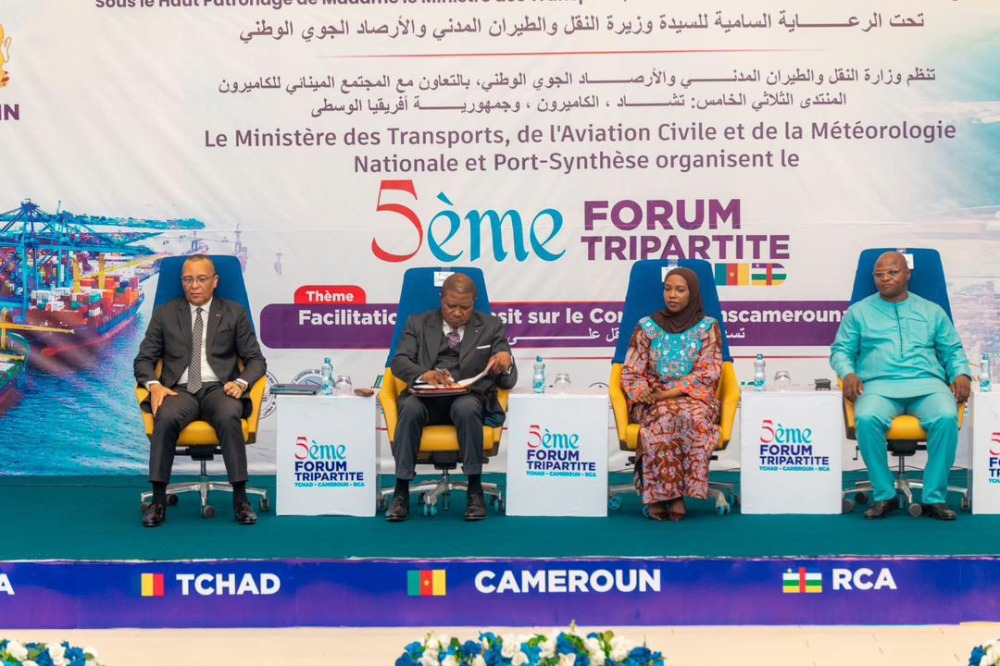
The 5th Tripartite Forum on Trans-Cameroonian Corridors concluded in N'Djamena, Chad on May 13, 2026. Stressing digital interconnection, infrastructure rehabilitation, and the removal of physical and administrative barriers.
Under the high patronage of Chad’s Minister of Transport, Fatima Goukouni Weddeye, and with the support of the governments of Cameroon and the Central African Republic, CAR, the Chadian capital, N’Djamena hosted the 5th Tripartite Forum from May 11-13, 2026. Organized by the Cameroon Port Community, known as "Port-Synthèse," the event brought together approximately 400 participants.
To address the critical challenges of transit and logistics across the Trans-Cameroonian corridors. The forum served as a high-level platform for examining the hurdles faced by economic operators from Chad and CAR when moving goods through the ports of Douala and Kribi.
Commitment To Action
The 5th Tripartite Forum concluded with a call for "concrete, realistic, and operational" recommendations. By focusing on digital interconnection, infrastructure rehabilitation, and the removal of physical and administrative barriers, Chad, Cameroon, and the CAR aim to transform the Trans-Cameroonian corridors into a seamless artery for regional economic integration.
The forum emphasized a commitment to move from a biennial (every two years) review to a more frequent, performance-based monitoring system. The reduction of checkpoints from 149 to 29 stands as the benchmark for success. However, the participants warned that "informal" mobile patrols must not replace the dismantled fixed posts. The 6th Tripartite Forum was officially awarded to the Central African Republic, to be held in Bangui in 2028.
Review Of 4th Forum Recommendations
A central component of the N'Djamena summit was a rigorous review of the progress made since the 4th Forum held in Kribi, Cameroon in January 2024. The findings revealed a mix of significant achievements and areas requiring further effort: Cameroonian Customs successfully simplified GPS fee payments, reducing the cost from 35,000 FCFA to 25,000 FCFA. Furthermore, the fee for GPS placement in the CAR was aligned with Cameroonian rates, dropping from 75,000 FCFA to 10,000 FCFA.
Stickers In Place Of GPS
The use of stickers as a substitute for GPS beacons when they are unavailable has been institutionalized. Additionally, "first-in, first-out" online request systems for beacons have been automated to improve transparency. Both the Port of Douala and the Port of Kribi have implemented "ristournes" (rebates) for shippers, with Chad and CAR shipper councils (Conseils des Chargeurs) actively involved in their distribution.
Major milestones were reached, including the widening of the eastern exit of Douala to Dibamba. The Port of Douala also saw the completion of ten new warehouses and a cereal terminal with eight silos.
Vision Of Shared Prosperity
The forum opened with powerful reminders of regional interdependence. Mahamat Brahim Siam, representing the Mayor of N’Djamena, highlighted the city’s role as a strategic crossroads between the Sahel and Central Africa. He emphasized that logistical infrastructure must be a "common lever of prosperity" for all three nations.
Cyrus Ngo’o, President of Port-Synthèse and Director General of the Port Authority of Douala (PAD), noted that the organization has spent three decades evolving into a vital tool for promoting Cameroon's port potential. And facilitating foreign trade for landlocked neighbors. He mentioned the future expansion of this cooperation to include other neighboring states like Congo, Niger, and the Democratic Republic of Congo.
Modernizing Port Operations
The forum detailed massive investments aimed at making Cameroon’s ports more secure and efficient: For Douala-Bonabéri Port, enhancements include a 20,000 m² secured parking area for transit trucks. A new "VTS" maritime surveillance system, and the deployment of shuttle buses for port users. The port has also modernized its road network with 19 kilometers of new roads.
For Kribi Port, the finalization of Phase 2 has increased quay and terminal capacity, allowing for the reception of larger vessels. Dedicated land reserves have also been set aside specifically for landlocked partner countries. The Douala Container Terminal (RTC) is now presented as 100% digitalized, while the Port of Kribi continues to integrate its information systems to fluidify operations.
Persistent Challenges, Road Ahead
Despite these advancements, the forum's delegates, including CAR Minister representative Yagbanga Fred Ferlin, pointed out that high costs and administrative hurdles persist. The forum identified several critical "unfinished business" items. Planned dry ports in Chad and CAR have not yet been built or connected to maritime terminals. Bilateral agreements on land transport between Cameroon and its neighbors are still being finalized, and a clear timeline for their signature is needed.
Minister Fatima Goukouni Weddeye emphasized the urgent need to suppress "tracasseries" (harassment) along road corridors and further accelerate the digitalization of transit procedures. While, the establishment of a dedicated Corridor Management Authority by CEMAC and ...
Cet article complet est réservé aux abonnés
Déjà abonné ? Identifiez-vous >
Accédez en illimité à Cameroon Tribune Digital à partir de 26250 FCFA
Je M'abonne1 minute suffit pour vous abonner à Cameroon Tribune Digital !

- Votre numéro spécial cameroon-tribune en version numérique
- Des encarts
- Des appels d'offres exclusives
- D'avant-première (accès 24h avant la publication)
- Des éditions consultables sur tous supports (smartphone, tablettes, PC)







Commentaires