

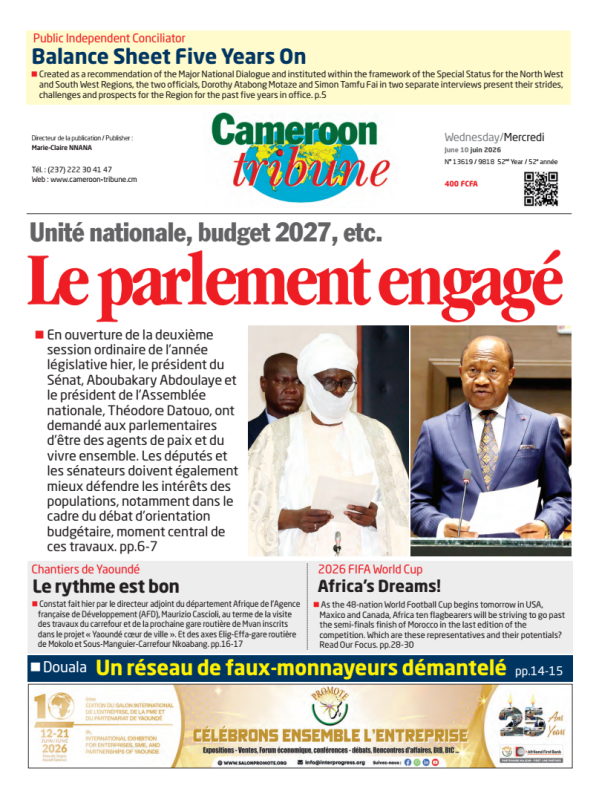
Public Independent Conciliator: Balance Sheet Five Years On!
- Par Roland MBONTEH
- 10 Jun 2026 08:23
- Likes

“We Have Resolved 121 Disputes Out of 197 Complaints”: Dorothy Atabong Telelen Épouse Motaze, Public Independent Conciliator for the South West.
The institutions that were put in place as a recommendation of the Major National Dialogue organised in Cameroon in 2019 turn five years today June 10, 2026 following the appointment to office of the frontline leaders in 2021 by the President of the Republic. Instituted within the framework of the Special Status for the North West and South West Regions, the two Public Independent Conciliators each have a six-year non-renewable term of office. From when they each took the oath of office in July 2021, they have carried out their missions as an independent institution charged with ensuring the amicable settlement of disputes between users and Council authorities. The two Public Independent Conciliators in separate interviews give their strides and challenges for the past five years in office. Read on!
The Public Independent Conciliator for the South West is five years. Born from the Major National Dialogue of 2019. How has the OPIC been operating all these while in terms of fulfilling its missions? I am convinced that our institution has been performing commendably in the fulfilment of its missions. Five years down the lane, the institution has deployed significant efforts in creating awareness about its existence and missions, ensured the settlement of disputes between citizens and local authorities, educate citizens on their rights and obligations as users of Regional and Council services, persistently urged local authorities to respect their ethical obligations, regularly published our annual reports to present the state of relations between citizens and the regional and council administrations as well as made some recommendations on how service delivery in certain domains of local public service can be improved. It may be of interest to know that our outreach and proximity activities have taken us to all six divisions and almost all the subdivisions of the Region. Indeed, we have been to 27 out of the 33 municipalities in the region where we organized townhall meetings early this year. We have also deployed Community -Based Liaison Officers in all the 31 subdivisions of the Region to serve as relay in the various communities. What are some of the major achievements of the institution in the region? As an institution whose ultimate objective is the promotion of cordial relations between the Regional and Local Authorities and citizens through the use of dialogue, one cannot assess the accomplishments of our institution in the same way as one would for an entity charged with constructing infrastructure or in the education sector with which I am highly familiar and where accomplishments could be measured in terms of the performance of students and pupils in official examinations or excelling in other disciplines. However, some of the main axis of performance include aspects such as; Effective Functioning and Established Presence on the field. In five years, OPIC has moved from a legal concept to a working institution. Operating from the Regional Capital of Buea. It has had some one-on-one concertation seminars with all the seven municipalities of Fako, three municipalities of Kupe-Muanenguba, three municipalities of Lebialem, four municipalities of Manyu, five municipalities of Meme and in Ndian, all the municipalities of the Bakassi Pernisular in a joint concertation seminar. On the creation of awareness, we started from zero awareness in 2021. Today, market women in Konye, bike riders in Limbe, farmers in Alou and Wabane, Quarter heads in Eyumojock and Tinto, traditional rulers in Nguti, fish traders in Idenau, Isangele and Ekondo-Titi just to name a few, do not only know about OPIC, but more importantly, have a better functional relationship with their Local Council administration. I am convinced that if you approach citizens in these municipalities, many will be able to say something about the actions of OPIC and what it means. Service Monitoring: the publication of our annual reports is closely linked to monitoring the provision of services by the regional and council administrations, assessing the state of relations between citizens and the local authorities through an objective evaluation of services rendered to citizens by the South- West Regional Assembly, the two City Councils and the 31 Coun...
Cet article complet est réservé aux abonnés
Déjà abonné ? Identifiez-vous >
Accédez en illimité à Cameroon Tribune Digital à partir de 26250 FCFA
Je M'abonne1 minute suffit pour vous abonner à Cameroon Tribune Digital !

- Votre numéro spécial cameroon-tribune en version numérique
- Des encarts
- Des appels d'offres exclusives
- D'avant-première (accès 24h avant la publication)
- Des éditions consultables sur tous supports (smartphone, tablettes, PC)








Commentaires